Bondi Survivor Gives Thanks at Ohel Alongside Australian Ambassador
by Moshe New – chabad.org
Yanky Super, a 24-year-old paramedic and volunteer on duty with Sydney’s Hatzalah emergency medical services, didn’t even hear a shot fired at Chabad of Bondi’s ‘Chanukah at the Sea’ event before he felt a bullet hit him in the back, collapsing his lung. One of the scores wounded during the Dec. 14 terror attack at Bondi Beach, Super was rushed to the Royal North Shore, where he spent five days in the ICU and weeks in recovery before he was finally discharged.
On Tuesday morning, Super stood at the Ohel—the resting place of the Rebbe, Rabbi Menachem M. Schneerson, of righteous memory—not as a victim, but as a survivor offering gratitude.
The Sydney-based paramedic had come directly from the airport, making the Ohel his first stop after landing in New York. It’s been just seven weeks since he was hit by a terrorist’s bullets, but Super has returned to fulfill a promise he’d made to himself in the immediate aftermath of the shooting.
“As soon as I can travel, I’m going to the Ohel,” he had told his brother Shmuel when he woke up from the first of his many surgeries.
He arrived alongside his close friend Rabbi Mendy Berger, himself a survivor, who had shielded children during the attack. The pair direct Nitzutz, an organization for young adults in Sydney, and arrived in an icy New York—a far cry from the blazing Australian summer they left behind.
“We are very grateful to the United States for collaborating with the Australian government to facilitate our visit,” Berger told Chabad.org. “On our way to New York, we were able to stop in Los Angeles to express our appreciation directly to Tanya Bennett, Consul-General Los Angeles, for the government’s consistent support. It’s a sentiment we’ve felt from across the full spectrum of society, and in particular, from the Jewish community.”

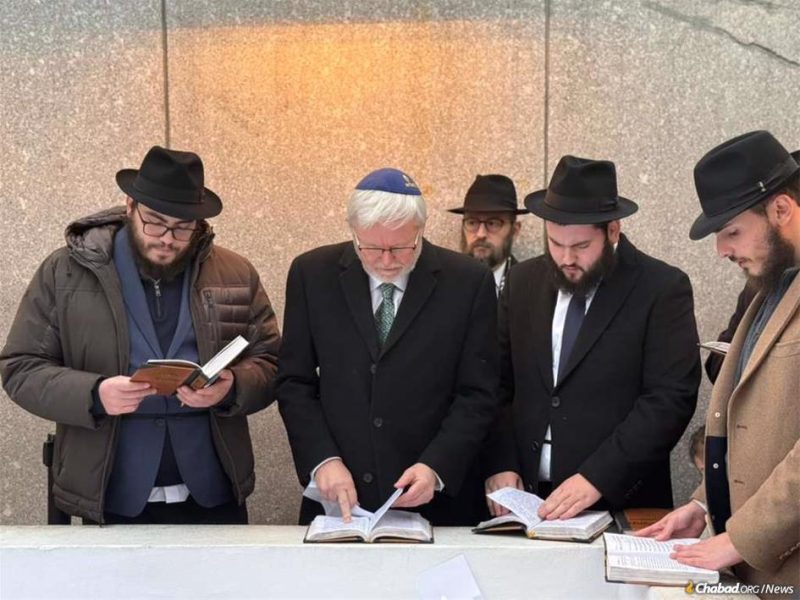
At the holy site, they welcomed former Australian Prime Minister Kevin Rudd, who now serves as Australia’s Ambassador to the United States. This marks the first time a current or former Australian prime minister has ever visited the Rebbe’s resting place, now joining major nations whose leaders have visited including: President Donald Trump of the United States; President Javier Milei of Argentina; President Isaac Herzog of Israel; and Albanian Prime Minister Edi Rama, among others.
“It’s an honor to be with you,” Rudd told Super and Berger, quoting Psalms, before they entered the Ohel. “The reason I’m here this morning is to honor all of you as you ‘walk through the valley in the shadow of death.’ I understand that these are hard things [that you went through] and you got through. In any way that my being here is useful, I’m here to support.”
The Bondi Beach Massacre
On Dec. 14, just 58 days ago, a father and son Islamist terrorist duo opened fire on Chabad’s Chanukah celebration in Bondi, killing 15 and injuring dozens more. The assault—on the first night of Chanukah—sent shockwaves through Australia and the world at large. 15 people were killed, including Chabad rabbis Rabbi Eli Schlanger and Rabbi Yaakov Levitan. Super, who had become a paramedic at the end of 2021, was among those shot.
Berger witnessed his friend go down. “They were unbelievable moments,” he told Rudd on Tuesday. Rather than flee, Berger acted, shielding a group of children and ushering them into his car to safety.
Super still has shrapnel lodged in his body— deemed too dangerous by surgeons to remove. Though, as he told an amused Rudd, “they don’t set off metal detectors.”
The Australian government’s response to the attack has been resonant. The NSW government instituted a ‘One Mitzvah for Bondi’ campaign; the nation observed a National Day of Mourning; and Super is proud to say that he has been visited by three of the last five of the nation’s leaders: former Prime Ministers Scott Morrison and Malcolm Turnbull, Albanese himself on multiple occasions in his Sydney office, and now, a fourth: Kevin Rudd at the Ohel.

A Place of Prayer and Gratitude
The Ohel, located in the Cambria Heights neighborhood of Queens, N.Y., is the most visited Jewish site outside of Israel. Some one million people come each year—from global leaders to ordinary individuals seeking blessings and offering prayers. Bondi hero Ahmed Al-Ahmed visited the Ohel too when he came to the U.S. last month.
Super and Berger arrived with little fanfare, accompanied by two of his siblings and Rabbi Motti Seligson, spokesperson for Chabad-Lubavitch. Rudd was accompanied by Chris Turnbull from the embassy.
Shmuel Super, who lives in New York, recounted how he woke at 4 a.m. on the day of the attack to the news that his brother had been wounded. Not knowing what else to do, he ordered an Uber through a snowstorm and went directly to the Ohel, where he spent hours praying.
Rudd inquired how Super was feeling. Super, who looked healthy and excited to be in the United States, reiterated that as soon as he received clearance from his doctor, he booked the flight.
Rudd spoke about his own faith and how he finds his blessings “from below and above.” He recalled telling Rabbi Pinchus Feldman, dean and spiritual leader of the Yeshiva Centre in Sydney, “I’ll take all my blessings,” in response to receiving the Priestly Blessing.
“I have a huge respect for the Jewish community in Sydney,” Rudd said. “I have a lot of friends there.”
In an unplanned moment, as the group prepared to enter the Ohel, they encountered Mina Levitan, daughter of Rabbi Yaakov Levitan. Mina had just led prayers at the International Conference of Chabad-Lubavitch Women Emissaries banquet just two nights earlier.
Rudd then lit a candle. And then they entered the mausoleum. Inside, they prayed. For themselves, for Australia, for the Jewish community. Seligson brought the ambassador to the graves of Rebbetzin Chaya Mushka Schneerson, the Rebbe’s wife, and Rebbetzin Chana Schneerson, the Rebbe’s mother.
Super still has one more obligation to fulfill. He hasn’t yet recited Hagomel, the blessing of thanksgiving recited by those who have survived mortal danger. He plans to do so on Thursday morning, back at the synagogue adjacent to the Rebbe’s resting place.