Weekly Story: Leave A Brocha
by Rabbi Sholom DovBer Avtzon
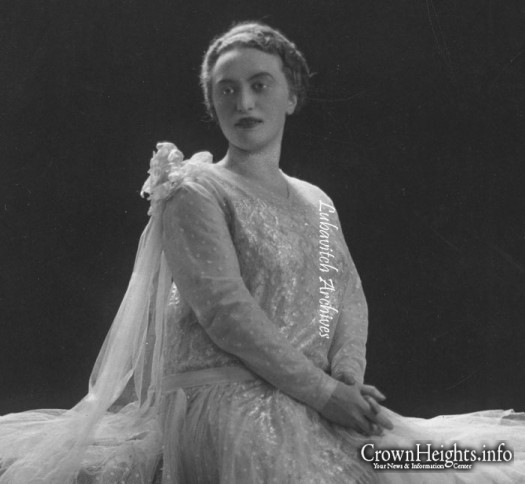
Being that this Monday is Chof-Beis Shevat, the 38th Yahrzeit of the Rebbetzin, I am posting a story about the Rebbetzin. As always, your feedback and comments are welcomed.
In the early chof’s (60s), the custom that a group of Bochurim (students) from Eretz Yisroel come and learn by the Rebbe for a year, began. To those Bochurim who merited to be part of the kevutzah (group) it was a wish and yearning coming true, they are finally able to see the Rebbe with their own eyes, and not through a picture (or a video which was a rarity in those days), but to stand in his presence and see and hear him.
One of those that came in those first few years, was a young man whose parents grew up in Russia, in the province of Poltava. In their home, they often discussed aspects of the Rebbe’s courtyard, where in addition to his house there was the Shul, and Yeshiva as well as other buildings.
While he was thrilled beyond description to have this tremendous zechus (merit) to see the Rebbe and stand close to him, however, his wish was not complete. He also wanted to see the Rebbe’s house, just as his father and grandfather had seen the house of the Frierdiker Rebbe and the Rebbe Rashab.
His fortune was that one of his close relatives had the merit from time to time, to help out in the Rebbe’s house. He ran over to this relative and asked (almost as a demand), if he could please bring him into the Rebbe’s house the next time he goes there. To his dismay his cousin told him, I’m sorry, but that is not how it works. No one but no one, is allowed into the house without explicit permission of the Rebbetzin. However, there are some times I am allowed to bring somebody in, and that is when there is a job that I cannot do on my own.
Being that you are my relative, the next time such a situation occurs I will ask the Rebbetzin if I could bring in someone who I know to help me. This satisfied him as he realized that his relative is going out of his way to arrange it for him but he’s doing it a manner that is appropriate. Sometime passed, maybe weeks or months, and his relative came to him and said tomorrow there is going to be a curbside delivery of an air conditioner to the Rebbe’s house.
Being that it is beyond my ability to carry it in on my own I asked the Rebbetzin if I could get someone to assist me and she replied yes. so you should be ready at this time to help me bring it in. The bochur was in 7th Heaven, he is finally going to have the zechus and ability to enter the Rebbe’s house.
At the appropriate time he came and helped his relative carry it into the house and place it next to the window where it would be installed the following day. While he was walking his eyes looked in every direction trying to remember and take in as much as his eyes could see and remember from the few rooms that he was able to see.
As they were about to leave the Rebbetzin came into the room and asked him, “Vei’mins bist du – who are your parents? When he mentions his parents’ name, the Rebbetzin said, “I remember that when I was growing up and they discussed the Chassidim of the Poltova region your family was discussed.”
She then continued and said to the two people, Bochurim’lach …. – Students (young men) I left some food in the kitchen., I will not be around there in order that you should not be uncomfortable eating.
I don’t know why, but for whatever reason that bochur felt that he had to reply, and said, I was raised in the chassidishe house, and I was taught that one should not eat in the Rebbe’s house. [Author’s note: Probably meaning, don’t make yourself too comfortable there, or in other words, remember that the Rebbe is Rebbe and not just a great tzaddik.]
The Rebbetzin replied, I too was raised in a chassidishe house, and I was taught (or my father taught me) that when we enter someone’s house, you are to leave a brocha, meaning say a brocha.
Obviously, they went into the kitchen and said the appropriate brochos.
From then on until now, whenever he enters someone else’s house, he makes sure to say a brocha.
A Taste of Chassidus
Bachodesh Hashilishi בחדש השלישTorah Ohr p. 66a
In this maamar, the Alter Rebbe asks what did Matan Torah accomplish in the Jewish people?[1] As you cannot say that now we have the ability to learn Hashem’s Torah and become connected to Him, as our forefathers learned Torah before Matan Torah, and their connection with Hashem was so powerful, to the point that the way it is described is that they were chariots of Hashem.
A chariot has no desire of their own, it goes wherever the driver wants it to go. So too our forefathers nullified themselves to the point that they had no will or desire of their own, their only desire was to do just what Hashem wants to be done.
But yet, as great as Yaakov’s sons were, they were unable to nullify themselves in front of Hashem to this extent. However, by Matan Torah, the entire Jewish Nation, although they were not close to the level of the twelve sons of Yaakov, and obviously not to our forefathers, they were able to completely nullify themselves to Hashem. And that is the accomplishment of Matan Torah, of giving every Jew the ability to completely nullify their desires and instead to solely focus on how to fulfill Hashem’s will.
The Alter Rebbe continues and says, in order to understand the question of how Matan Torah gave us this ability, we first have to understand, how our forefathers, the Avos, were able to nullify themselves to the point that they became a chariot and had no other desire whatsoever besides the desire to fulfill hashems will and desire. And also, why the generations after them couldn’t do so, until they received the Torah and then they had this capability.
Chassidus explains that there are two levels of Hashem’s radiance that is revealed in this world, which gives life to every entity in the entire.
The level of the lower one is called Ohr Hamimaleh; meaning the radiance of G-dliness is diminished till the point that the entities of creation are able to accept that radiance, without becoming nullified. In other words, in each entity there is a revelation that is appropriate to that specific entity, and it is a different amount that is shining in another entity.
Subsequently, when a person contemplates on this level of G-dlinness, they come to the understanding and realization that their existence is dependent upon that revelation of Hashem’s radiance, and without that radiance they won’t exist.
Once a person comes to this recognition, that their entire existence depends on Hashem’s radiance giving them life, they will definitely have feelings of love and awe towards Hashem and will serve Hashem to the best of their ability. However, that recognition could never bring the person to be willing to give up their life or even their desire in honor of Hashem. The reason for this is, since the person’s love to Hashem is based on the fact that He is the source of my existence. Subsequently, the person’s existence is paramount to everything else, and that they are not interested in doing.
However, when a person contemplates on the higher level the light of Hashem that is above the ability of the vast majority of people to truly grasp in its entirety, and comes to understand that there’s a power, an entity that is way higher than anything else in creation and in fact that is the only true entity. At that point they feel and sense that there are truly not an entity, as if they are nothing, if not for Hashem’s will that they should be something. So, when a person realizes that in essence they are nothing and their entire existence is only because of Hashem, then they are able to negate themselves completely.[2]
Our forefathers, being that they were so great were able to contemplate on this higher level of how Hashem’s radiance gives life to them and everything in this world. Subsequently, once they came to this realization that they are nothing, they negated and nullified any will or desire of their own, and only had the will and desire of Hashem, as He is their essence.
However, Yaakov’s twelve sons, as great as they were, could not reach the level of becoming a complete chariot. Their body or entity argued that I am an independent entity, and I also have a desire. And that thought of I am a separate entity (or any other sin), created a barrier between us and Hashem, as the possuk states, “For your sins are separating between you and Hashem,”[3]
When did the Jews gain the ability to once again nullify their will and desire completely to the point that they were completely nullified as if they are nothing, that was by Matan Torah. In other words, even though the Jews who received the Torah were not able to comprehend the level of Soveiv [as the Avos did], nevertheless, Matan Torah gave them the ability to nevertheless nullify themselves completely.
The accomplishment of Matan Torah in the Jewish people is that Hashem granted us the ability to completely nullify ourselves to Him on the same level as our forefathers did.
As noted, the Avos were able to comprehend on their own, that Hashem is everything and all the creations and the entire universe, as vast as it is, is all an extension of Hashem. In simple terms, they exist only because He exists in them, and as we say in Shacharis, “You [Hashem] existed before You created the world, and You exist in the exact manner after You created the world.” In simple terms this means, just as You were the only entity before creation [as there was nothing besides Hashem], so too after creation, there is nothing besides Hashem. This is what the prophet says, “I, Hashem has not changed.”[4]
The way Hashem accomplished and implemented this in us, is spelled out in the first three words of the Aseres Hadibros; Anoichi Hashem Eloikeicha that I am Hashem your G-d. Chassidus explains, these three words are three different levels of Hashem.
The highest level is Anoichi, I am who I am: meaning this is referring to Hashem’s essence even before there was any name whatsoever, in other words even before Hashem desired and thought of creating a world.
The word Hashem is spelled with a Yud, a Hei, a Vov and the second Hei. They describe the process of how Hashem created the world, so now we are speaking about a creation.[5] The third word, Eloikeicha, means the way Hashem is revealed in our body and life.
By placing these three words together, Hashem is informing us that when He is giving us the Torah, the Torah is His essence and never parted from Him. But He gave it to us in a manner that even though it is going through the process of creation (as alluded in the name Hashem), the level of Anoichi is going to be our new nature (which is represented by the name Eloikeicha). Subsequently, even though we on our own, are not capable of comprehending the greatness of Hashem at the level that our forefathers did, and our actions may have created barriers that try to separate us, Hashem granted us that ability of realizing that there is nothing besides Hashem.
[In essence, our forefathers came to nullifying themselves through their understanding of Hashem’s true greatness, and while we can’t reach that level of understanding, at Matan Torah we were given the ability of nullifying ourselves.]
The question then becomes, that was true when Hashem gave us the Torah at Har Sinai when he stated Anoichi Hashem Eloikeicha, however, how do we have that power now more than 3,000 years later?[6]
When we look at the Aseres Hadibros, this question becomes resolved.
The possuk before Anoichi, states that Hashem spoke to Moshe saying. Normally, when the Torah uses the word saying, it means that Hashem is instructing Moshe that he should give over this commandment or guidance that I am telling you to the Jewish people. However, here we cannot use that explanation, because not only were all the Jews who lived then standing at the foot of the mountain, but the souls of every Jew that are going to be were also there. So, what does leimor – to say, mean in this possuk?
David hamelech says in tehillim, Ta’an Lishoino Imruhseocha – my tongue shall say your words.[7] However, a deeper meaning to these words is when my lips speak words of Torah, they are expressing Your words exactly as You said them the first time at Har Sinai. Meaning to say, that it’s not that I am saying my understanding of the Torah, but I am expressing Hashem’s words. So when we learn Torah and verbally express it, it is a reenactment of Matan Torah, as if Hashem is saying it right now to us.
Therefore, our sages teach us, just as by Matan Torah we stood there in a state of fear and awe, so too nowadays when we learn the Torah, we should have that same feeling of fear and awe. And as noted that can be accomplished because when we learn Torah properly, it is as if Hashem is saying it anew.
And this is the accomplishment of Matan Torah as it relates to the Jewish people even nowadays
Rabbi Avtzon is a veteran mechanech and the author of numerous books on the Rebbeim and their chassidim. He is available to farbreng in your community and can be contacted at avtzonbooks@gmail.com.
[1] This should not be confused with the regular question of what did Matan Torah accomplish, above the Torah that was learned by the Avos and in the Yeshiva that Yaakov sent Yehudah to establish in Goshen, before they settled there.
The answer to that question is explained in numerous maamorim, that before Matan Torah, the mitzvos that the Avos did, did not bring a holiness into the object that they used to do the mitzvah with. Whereas, when even a simple Jew does a mitzvah with a materialistic object, that object becomes holy. For example, the string of tzitzis that got ripped off a young boys tzitzis, that string that was made out of wool, has holiness and therefore has to be buried in Shemos, together with seforim which are printed on paper that is made brom bark of a tree, etc.
[2] Chassidus explains that this higher level is the level of עילאה יחוד, as is expressed in the first possuk of Shema, while the second level is the level of תתאה יחוד, which is ex pressed in the possuk of שם ברוך.
[3] Yeshayuhu, 59:2.
[4] Malachi, 3:6. Chassidus then explains that the continuation of the possuk, (which simply translated to mean, that even though I hashem has not changed my opinion that bad must be eradicated, but nevertheless, I didn’t destroy you), is telling us, Hashem’s bewilderment at the complacent conduct of the Jewish people.
Being that you are aware that the creation of the world did not affect Hashem at all, and He is still the only entity in the world, how is it that you have not developed a true longing and desire to be united with Me, who is giving you life every moment?!
[5] The letter Yud is the smallest letter in the Aleph-Beis. That points to how Hashem contracted (by concealing Himself) in order that the creations won’t automatically feel His presence and become nullified.
That is followed by thye letter Hei, which shows an expansion from the letter Yud, to demonstrate that this spark of Hashem’s radiance, is spreading out into many creations.
Then we have the letter Vov, which is a Yud with a stem drawing it down, representing how Hashem’s radiance is being brought down into the world, and is expanded further by the second Hei.
[6] The giving of the Torah was in the year 2448, which is presently 3338 years ago.
[7] 119:172.