After Her Son Was Shot at Bondi, Manya Lazaroff Had To Live What She Taught
by Bruria Efune – chabad.org
For nearly three decades, Manya Lazaroff has been doing what all of her fellow Chabad rebbetzins, gathering for this week’s International Conference of Chabad-Lubavitch Women Emissaries, have been doing proudly and consistently—firing up the Jewish spark in every soul.
This past Chanukah, that mission was tested when her 20-year-old son, Leibel, was shot by terrorists at the Bondi Beach menorah lighting in Sydney.
Together with her husband, Rabbi Yossi Lazaroff, Manya co-directs the Rohr Chabad Jewish Center at Texas A&M University in College Station, one of the largest university campuses in the United States. With more than 70,000 students—and only a few hundred Jewish ones—College Station is both geographically and culturally isolated. The nearest major Jewish communities are hours away. Here, Jewish life is unexpected, but at Chabad, it’s bustling day and night.
Torah classes are packed throughout the week, along with guys’ nights and girls’ nights, and BBQs. At Kosher Cooking Club on Thursdays, you’ll find students braiding challah, singing, and absorbing what it feels like to prepare for Shabbat. On Friday nights close to a hundred students gather around the table for the traditional meal. On Shabbat mornings, prayer, study, meals, and conversations stretch long into the afternoon. The goal, Manya explains, is not uniform outcomes, but encouraging Jewish students to take pride and ownership of their Judaism by taking action, one mitzvah at a time.
“Every student’s journey looks different,” she says. “Every pivotal moment is unique. For one student, it means telling people they’re Jewish. For another, putting on tefillin. For another, building a Jewish home. The privilege is being part of that journey.”

On a campus where Jewish students are a small minority, Manya and Rabbi Yossi, veterans there for 28 years, empower them to see themselves as ambassadors. “They keep their eyes out looking for the other Jewish students on campus,” Manya proudly explains. “And when they find them, they invite them into our community. They see it more like a close-knit family, and that’s exactly how we want it.”
The nine Lazaroff children have been raised around this unusual family. Far away from the nearest typical Jewish community, these kids grew up with friends aged 18 to their early 20s. They come along to help out at events and sit at Shabbat tables side by side with the students.
This does not come without particular difficulties: At these tables, the children are exposed to the type of conversations that college students typically have, sometimes for the better, sometimes not. Very early on, Manya and her husband saw the unique challenges their children faced growing up in such an environment, nurturing them through it until it became a strength. It took attentive focus and open conversations and ultimately led to a special closeness within the family, and children gained a deeper understanding of the world around them.
“When you raise children in this environment,” Manya says, “they know who they are. They know why they’re here. It builds resilience.”
That resilience would soon come in handy in a way the Lazaroffs never imagined.

Thrust into Tragedy
During the predawn hours of Sunday, Dec. 14, the morning before Chanukah, Manya and Rabbi Yossi were asleep when their phones began ringing nonstop. They woke up to dozens of missed calls and messages from students and friends trying to reach them from around the world.
Their son, Leibel, was in Sydney, Australia, where he was working as an assistant to Rabbi Eli Schlanger at Chabad of Bondi. He had helped organize a massive public Chanukah celebration at Bondi Beach.
A niece arrived at their door and told them there had been a terror attack at the event, when two terrorists opened fire on the unsuspecting attendees. Fifteen were killed and forty injured.
At first, all they knew was that Leibel had been shot. Rabbi Schlanger too—and it didn’t look good. It took several phone calls and a lot of help from locals in Australia until they finally located their son.
“Deep inside, I knew he was alive, I knew he would be OK,” says Manya. “I had been learning and teaching Shaar Habitachon—a classic work all about trust in G‑d. Those lessons were now being put into practice at the most real level. Now I knew that I had to focus on the logistics and leave the rest up to G‑d. We were in His hands.”
The Lazaroffs soon learned that Leibel had been through a life-saving surgery. He had been shot multiple times while saving an injured police officer, and was in critical condition.
Within hours, the Lazaroffs were on their way to Australia, leaving their younger children—aged four, two, and one—with their older children and daughters-in-law. The journey from College Station to Sydney took nearly two days.

Somewhere along the way, in an airport, they lit the Chanukah menorah. An Israeli waiter joined them. The Lazaroffs told him about their son, and he spoke about his parents’ experience with persecution when they were expelled from Iraq. Together, they shared hope and faith. The Lazaroffs’ instinct to keep spreading the light of Chanukah was not shaken.
Before boarding her flight, Manya wrote a message that would later circulate widely: “…The trauma is real, the feelings so heavy and yet—we can NOT allow the darkness to become internal.”
This was darkness against light, she explained. An existential struggle. We could not allow the darkness to have power over us, to define our narrative. It was time to shine as ambassadors of light.
She realized in that moment, that she was being asked to live what she had spent decades teaching.
“For years, we have taught these ideas—about challenges, about faith. And suddenly, I had to step into them,” she says. “My role as a Chabad emissary gave me the tools to handle this insanity.”

Surrounded by Light
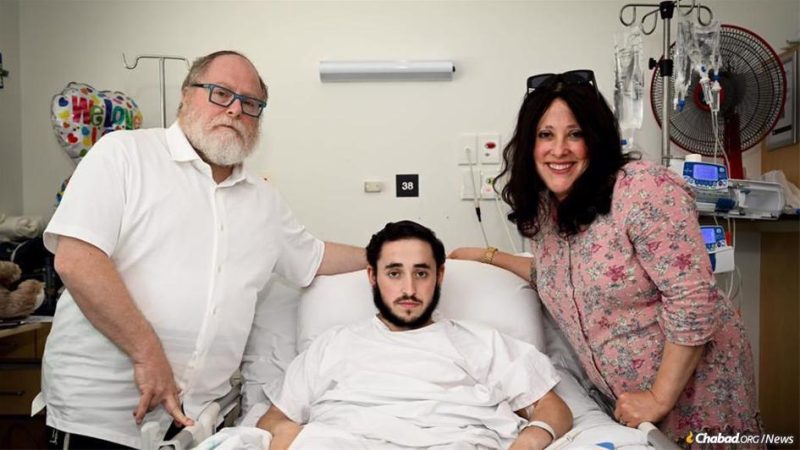
When they arrived in Sydney, Leibel was still unconscious. He would eventually undergo eleven surgeries.
But he was never alone.
Fellow Chabad emissaries, Jewish community members, students—people he had known for only weeks—filled his hospital room in shifts. They brought a prayerbook, a Chitas, and a menorah. They prayed by his bedside. Nurses watched in amazement as strangers treated one another like family.
When Leibel woke from his medically induced coma, he began to understand what had been happening beyond the hospital walls. He also learned that thousands of people around the world had wrapped tefillin, lit menorahs, and prayed in his merit.
“That’s why I’m alive,” he told his mother.
Before surgery, he had understood the stakes clearly. “Either I wake up,” he said, “or I don’t.” When he did finally wake up, he said, he felt not only gratitude but purpose.
Back at Texas A&M, Chanukah at Chabad continued.
A visitor later described walking into the Chabad center that Sunday afternoon expecting heaviness, grief, and silence. Instead, he found music, movement, and preparation for the campus menorah lighting. Students—and even Leibel’s siblings—were asking how they could help others.
On campus that night, hundreds gathered to light the menorah. One of Manya’s sons looked out at the crowd and thought: This is who we are.
“We don’t pretend it doesn’t hurt,” she says. “But we also don’t shrink.”

A New Type of Community Work
Leibel’s time in Sydney was meant to last longer, until September 2026. He had fully dedicated himself to his role—studying Torah, teaching, organizing, cooking, shopping for Shabbat, delivering soup to the elderly. He had found a place where all his gifts were needed.
That chapter ended abruptly, as he finally returned home to Texas this week to continue his recovery, seven weeks after the attack. The sense of an uncompleted mission is real.
But Manya sees his work continuing in a different form.
“He knows why he was there,” she says. “And he knows that this is also part of it.
“We’re not going to be worse for the wear,” she says. “We’re going to be more united. Stronger. That doesn’t happen on its own—it takes work. But we’re stubborn.”
Since October 7, and especially since the Bondi attack, Manya has watched Jewish students on her campus grow louder, prouder, more visible.
“The common response to threats and intimidation is to hide and retreat,” she says. “This time,
it’s the opposite.”
Her message—to students, to readers, to anyone afraid—is direct.
“Fear is immobilizing. It makes our light smaller. And that’s exactly what darkness wants.”
The Jewish response, she says, is not to obsess over every act of hatred but to add light.
“That’s what the Rebbe [Rabbi Menachem M. Schneerson, of righteous memory] taught us. Darkness isn’t chased away by fighting it—it’s diminished by light.”
For Manya Lazaroff, that idea is no longer theoretical. It has been tested, lived, and chosen again and again.
And it continues to shine.