A Chassidic Music Festival’s Journey to the Heart of Israeli Culture
by Yossi Reicher – chabad.org
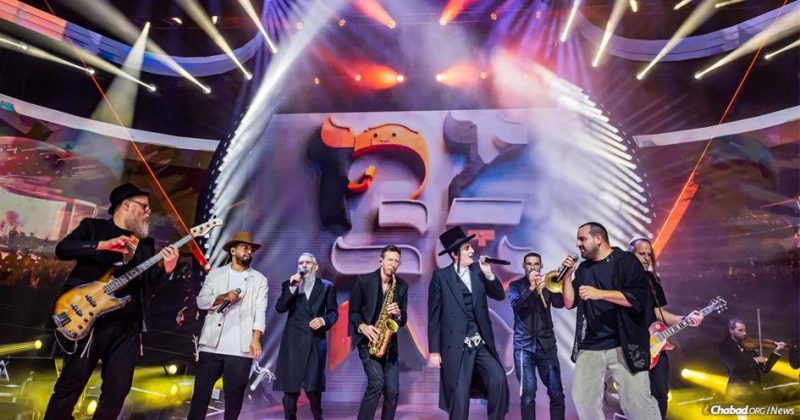
Over the course of eight days in December, more than 100,000 people came through Jerusalem’s Binyanei HaUma International Convention Center to experience Tzama, an immersive journey through Chabad Chassidic literature, thought and music.
But what visitors take from Tzama, more than anything, is spirit.
The unique week-long gathering spans 60 events in total—exhibitions, book fairs, late-night farbrengens (informal Chassidic gatherings) with noted rabbis and teachers that run until the early hours of the morning, and, of course, music. Tzama’s 22 concerts feature the biggest names in Jewish and Israeli music, including Ishay Ribo, Amir Dadon, Avraham Fried, Benaia Barabi, Akiva and Motty Steinmetz, performing the joyous and soul-stirring melodies of Chabad.
One evening, as the nightly show got underway, the band hit the opening notes of an upbeat niggun. An electric feeling took over the room that didn’t go away until long after all the attendees went home. Thousands of people jumped to their feet, arms locking over shoulders. It isn’t just a slick production: Tzama is an experience to participate in. Something reaches out instantly, leaving no room to remain a bystander throughout the show.
A security guard was overwhelmed by the melody of the Arba Bavos, the mystical Chassidic melody composed by Rabbi Schneur Zalman of Liadi, the founder of the Chabad-Lubavitch movement and known also as the Alter Rebbe.
“I just broke down in tears … I don’t understand what happened to me,” he confessed. He’d never encountered the tune before, he added. “It felt otherworldly, touching a deep part of my soul.”
This is Tzama, a multi-faceted project to make Chassidic teachings accessible to audiences who might never have encountered them otherwise. Now in its 16th year, the annual event has become an Israeli cultural phenomenon, with crowds growing every year.

An Immersive Experience
Two concerts take place every night—held on alternating evenings for men and women—and as people enter the venue they walk through elaborate exhibitions on Chassidic teachings, history and spirit.
On one screen, Eitan Horn, a former hostage who was captured by Palestinian terrorists on Oct. 7, 2023, and among the last captives in Gaza to be freed, shared his sudden impulse, as he languished underground, to fast on Yom Kippur: He had never done it before. What had driven him to do so now, in a Hamas tunnel of all places? The video then cut to the Rebbe, Rabbi Menachem M. Schneerson, of righteous memory, explaining the inherent power of the holy day of Yom Kippur, and its unique ability to bring to the surface a Jew’s everlasting neshamah.
Even when the concerts were over for the evening, Tzama wasn’t yet done. Entering the convention center adjacent to the concert hall, the visitor encountered thousands of books on Chassidut stacked high. Tzama is in fact the largest Chassidic book fair in the world. From the Hebrew-language Tanya for People Like You and Me—a modern-day adaptation of the Alter Rebbe’s Tanya, to Likkutei Sichot—the Rebbe’s landmark weekly talks, attendees piled books into shopping carts, before moving to the next table, leafing through pages and filling their carts even more.
“Tzama helps me see the beauty in Chassidut and how it fits into real life,” said Maya, a communications student from Tel Aviv who has attended for three consecutive years. “Ideas like hashgacha pratit (Divine Providence), the power of a single mitzvah, and the Jewish soul do not feel ancient. They feel alive and applicable, even in a modern, busy world. I come back every year to be reminded of that.”
The festival is held over the week of the 19th of Kislev, which commemorates the liberation of Rabbi Shneur Zalman of Liadi from a Czarist prison in 1798, and is referred to as the “Rosh Hashanah of Chassidism.”
“Niggunim are the universal language of the neshamah,” explains Bracha Shilat, who founded Tzama together with her husband, Rabbi Moshe Shilat. “Music opens people’s hearts to deeper teachings and ideas. Jews of all backgrounds: Litvaks, Chassidim, national religious, and people who don’t yet keep Torah and mitzvot. They all come seeking something, and they find that Chabad Chassidut speaks to their souls.”

A Year-Round Movement
Tzama’s impact extends throughout the year: it produces daily podcasts, creates study guides, and an extensive curriculum program complete with periodic voluntary exams. The finals, featuring thousands of teens and young adults who studied the entire Tanya over the course of the year, takes place over the week of Tzama.
“People aren’t just coming for entertainment,” a staff member explained. “They’re celebrating a connection to these teachings that they maintain every day in synagogue, at home or on their morning commute.”
Of the 100,000 participants this year, roughly 40,000 were young people. That’s where the hunger seems most acute.
Aviv Alush, a famed Israeli actor and musician who performed at the festival, noticed something striking about how these teenagers engage.
“It opens my heart to see them,” he told Chabad.org. “They’re asking deep questions. They’re looking for G‑d. They pray with sincerity and courage that I don’t recall seeing in my youth.”

A Melody in Gaza
The transformative power of Tzama reaches far beyond the walls of the conference center.
During the war, battling against Hamas and other terrorists, Staff Sergeant Shimon Cohen found himself in a ruined building in the Gaza Strip. Covered in smoke and dust, he grabbed a can of spray paint and turned to a bare wall. He wrote three words from Isaiah: Utzu eitza vetufar—“Plan a conspiracy and it shall be annulled,” which refers to the evil plans cooked up for the Jewish people by their enemies, and G‑d’s continued salvation.
Cohen recalled the words from a Chassidic melody, which kept playing on repeat in his head during those difficult days. He’d first heard it at Tzama. Throughout the fighting, the message of the age-old words kept him going. “It accompanied me in Gaza. Every time I felt a bit low—what power those words have. They gave me tremendous confidence.”
Hours later, an explosion left Cohen with shrapnel wounds in both legs. During the evacuation and ensuing surgeries, the melody stayed with him. From his hospital bed, he set himself a goal: to be back on his feet by the 19th of Kislev, the opening date of Tzama.
It wasn’t always that way for Cohen. He grew up viewing Chassidism as shallow, something that offered no value to his life. A friend had to drag him to Tzama, and he showed up with a plan: enjoy the show, ignore the message. “I thought I could eat the fruit and throw away the peel, so to speak.”
Then Evyatar Banai started singing Padah B’shalom, a Chassidic melody set to the words of the Psalmist, “He redeemed my soul with peace.” “I started to tear up. It’s such a deep melody. It swept me inside.” The melody broke through. “Something in me started to allow myself to get to know the depth in the Chassidic world. The ability to be a Jew in the very mundane and to bring the essence of G‑d into that. It is amazing.”
From his hospital bed, Cohen listened to the Tzama podcasts, and began studying Chassidic texts. A year later, he began the Lev Ladaat daily Tanya study program, rigorously studying and taking exams on Tanya.

Cohen’s story was shared on stage during the festival. He serves as a prime example of what Tzama accomplishes long after the curtain call of the final show.
The festival’s production quality rivals that of major concerts, with dazzling motion graphics, sophisticated staging and cutting-edge technology that reframe 200-year-old melodies while maintaining their authenticity, creating an immersive experience for attendees.
Stage manager Yaakov Asraf described the goal: “Our aim is for every participant to see themselves on the stage. Through visual effects, we bring the emotions and message of the niggun in a tangible way.”
Musical director Naor Carmi believes the technology is just the vehicle. “The niggunim themselves speak to the people. We try our best to bring out the nekudah—the inner message—of each niggun. That’s what attracts so many people to Tzama. The melody and message itself.”
Sixteen years after it began, Tzama is opening the doors of Chassidic thought and inspiration to the broadest audience of Jews in Israel, echoing a larger trend that is seeing authentic Jewish spirituality enter the mainstream of Israeli society.
“If words are the pen of the heart,” the Alter Rebbe taught, “then song is the pen of the soul.”
Tzama has helped make that language accessible to all.