Weekly Story: The Rebbe’s Shabbos Farbrengens Part 3
by Rabbi Sholom DovBer Avtzon
As noted last week I am writing a third installment about the Rebbe’s Shabbos farbrengens, and perhaps some other time we will continue this series. I thank those who brought to my attention a few corrections and points.
A. When the Rebbe would say a maamar in the format of a sicha his eyes were open and not closed. B. In addition to the Friday Maamor which he said on Erev Yud Shevat 5730, when the Sefer Torah to greet Moshiach was completed, there was one more time he said a maamar on Friday, and that was on Purim 574, in the small beis hamidrash upstairs.
C. Until the late lameds (70s), a weekday farbrengen began at 8:30 and then the Rebbe changed it to 9:30.
D. The niggun that Reb Yoel used to begin the farbrengen with, before changing it to the niggun that was connected to the Rebbe’s kapital, is nigging number eight in Sefer Haniggunim.
E. The maamorim of the last five volumes of the Rebbe’s maamorim, which are the vast majority (almost three quarters) of the maamorim that the Rebbe reviewed and was magiu was done between the years 5747 and 5752, a period of five plus years, and not as I mistakenly wrote that it was over a 15-year period.
Once again, I thank all of you for your feedback and comments, as you see it is extremely helpful and extremely beneficial.
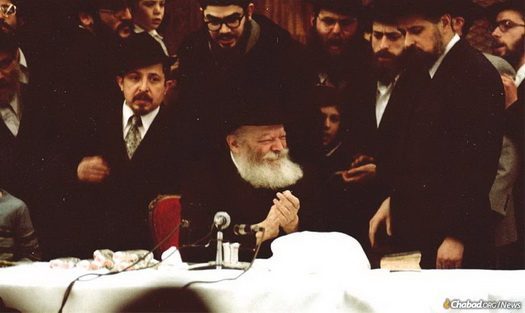
Knowing if the Rebbe would be farbrengening this Shabbos.
Being that In the early chof’s (60’s) the Rebbe began farbrengening on additional shabbosim beside Shabbos Mevorchim and special days in the Jewish or Lubavitch calendar, the chassidim wanted and indeed had a need to know if the Rebbe is going to farbreng that Shabbos or not.
For example, during the summer months many families rented bungalows in the country and the husbands didn’t want to miss a farbrengen, so how are they going to know if the Rebbe would be farbrengening or not?[1] Additionally, the yeshiva in Newark and then in Morristown constantly had the same question, should the yeshiva remain open for the Shabbos or should everyone go to New York to be by the farbrengen? One more scenario, the chassidim who lived out of Crown Heights wanted to know whether they should walk to 770 or they could remain at home. So, they tried to figure out if the Rebbe gave any hint that he would be farbrengening.
One of the most obvious hints was, if the Rebbe asked somebody, are you going to be here for Shabbos?[2] After a few people were asked this and there was a farbrengen that Shabbos, everyone realized that that was a hint, as if the Rebbe was saying that if you stay you would hear a farbrengen, or that during the coming farbrengen I will be answering the question that was asked to me, Etc.[3] Another tell-tale sign was that, until the histalkus of the Rebbetzin, the Rebbe normally did not daven Shacharis with the minyan. However, on Monday, Thursday and whenever there was a krias hatorah he would come to 770 before ten in the morning, so that the minyan in the beis hamidrash upstairs would not have to wait for him, and he would enter before the Sefer Torah was taken out of the Aron Kodesh.
He would then remain in the Zal until after the Sefer Torah was returned to the Aron Hakodesh after the Kaddish Tiskabel, which is said immediately after Uva Litzion.
Normally (on every Monday) while the minyan was saying Ashrei Uva Litzion the Rebbe would recite Tehillim.[4] However, people noticed that sometimes on Thursdays the Rebbe would be looking very intently inside a chumash. After a few times they realized that the Rebbe was concentrating on a Rashi, and that was the Rashi which the Rebbe explained during the Shabbos farbrengen.[5]
Sometimes we didn’t have those signs and people went away for the Shabbos to the country or other places and Yeshiva Morristown did not come into New York, as everyone thought there wouldn’t be a farbrengen. But then on Friday night the bochurim noticed that the Rebbe left his room much later than normal, and the next day there was a farbrengen. After this happened a few times, people believed that the Rebbe was learning and going through various seforim, as he was preparing to bring out his explanation on Rashi or to clarify something else.[6]
One more clue that lasted for many years was, if the Rebbe motioned in Kedusha, by Hu Eloikeinu to sing that meant he will farbreng. This stopped on Shabbos Parshas Maasei, 5740, when the Rebbe said in a sicha,why does the minyan wait for me to encourage the singing by Hu Eloikeinu, it is now in middle of the three weeks, and we need Hashem’s assistance.
Now, even when everyone believed there was a going to be a farbrengen, obviously you could not announce it on your own. Yes, the Rebbe remained later in his room Friday night than usual, but it was possible that it was for other reasons as well. So they needed a clear and explicit sign to know whether to announce if there is a farbrengen or not. The most direct sign was when the Rebbe would tell Reb Yosef Waldman before davening that the Rashi sicha would be on a certain possuk.[7] So then they had a clear sign, as the Rebbe had clearly told somebody that he’s going to farbreng.
But if that did not happen, or if there was no other indication that there is going to be a farbrengen, after davening the gabbai would make a few announcements. One announcement would be in whose house there would be a melave malka. At the end of all the announcements the gabbai would say and mincha would be at such and such a time. However, before making that final announcement he would look at the Rebbe. If the Rebbe remained standing in his place, that meant the gabbai should continue and make that announcement. However, if the Rebbe was planning to farbreng, before that announcement would be made, the Rebbe would pick up his siddur and the other seforim[8] that he brought down with him, and that was a sign that mincha would be after the farbrengen.
A Taste of Chassidus Vu’eira El Avrhom וארא אל אברהם Torah Ohr p. 55A.
This week’s Parsha begins with Hashem saying to Moshe, that while I revealed Myself to the Avos (our forefathers), however, only the level of Sha-kai was revealed to them, not the level of Havaya [Hashem’s name of Yud, Hei, Vov and another Hei].
This obviously means that they were only allowed to see or experience a lower level of Hashem’s greatness, but now at Mattan Torah, a higher level will be revealed.
In this maamar, the Alter Rebbe explains the practical difference between the level of revelation of G-dliness as it is now, in the time of our exile and as a it will be when we finally merit to the coming of Moshiach.
He bases it on the midrash that compares these two periods (of Exile and Redemption) to the time of pregnancy and the time of birth. When a baby is in its mother’s womb, the body is basically folded, that the child’s head is by its knees and even in the later months when the child is already fully developed its eyes does not see, the ears do not hear, the mouth does not eat rather the food comes through the placenta into its belly. The baby begins to breathe on its own when it is finally born, and it gives out its first cry. Then the head slowly begins to function; it eats with its mouth, slowly opening up its eyes, Etc.
From this we see that the development of the brain and its influence on the emotional characteristics of the child / infant only begins after it is born.
[In order to be able to understand this thought easier, I would preface it with the following story.
When the Mitteler Rebbe was around nine years old, he noticed a group of his fathers outstanding chassidim, including Reb Yosef Kolbo and Reb —, standing, and some of them looked distraught.
When he was asked if he knows what is causing them this anxiety, he replied, Dovid HaMelech states it clearly in Tehillim. There it is written [and he began translating the words homiletically], their sadness comes from the financial situation which humans involve themselves in. These outstanding Chassidim have a mouth, and while they explain my father’s teachings of Chassidus, the truth is they do not speak his teachings. Similarly, although they have eyes and seemingly see that Hashem controls the entire world, evidently, they don’t see this when it comes to their own financial situation. For if they saw that everything comes from Hashem they would not be distressed.
And now we will proceed with the Alter Rebbe’s explanation.]
One of the aspects of feelings is that they can change. As a child/person grows and develops, their interests and desires evolve. One year they are interested in something, and a year or two later they decide it is unworthy of their attention and interest. They need something of greater importance etc.
So when we compare exile to the state of pregnancy, that is saying that although the Avos, had a tremendous recognition and bond to Hashem, it is compared to an emotional bond- meaning one that is not by definition permanent. Yes, by them it was, but that was because they decided it to be so, not that that level of recognition demanded it to be so.
In practical terms it means as follows:
Vu’eira El Hu’Avos, does not only mean, “And I revealed Myself to the forefathers,” it also means, I am constantly revealing Myself to them, not only to them in Gan Eden, but in this physical world as well, even though they are not physically here. The Alter Rebbe explains that is referring to the aspects of the Avos that are part of every single Jew.
But it is only on a lower level, and just as by Mattan Torah the Jews were elevated, so too when Moshiach comes, may it be speedily in our days, we will be elevated to even a higher level.
When a child is developing in the womb, there is a heartbeat, a brain, eyes etc., however, the most noticeable thing is the growth. So too, when a Jew is in their spiritual golus (exile/loss of connection to Hashem), while they are fulfilling the mitzvos and learning Torah, it may be out of rote and habit, without feeling.
This is because the person doesn’t feel Hashem’s presence in the world. Yes, the person definitely believes that Hashem exists and is the Creator of the world, but doesn’t feel His presence in their day-to-day life.
However, Matan Torah accomplished that Hashem’s presence is felt in this world and can permeate the physical world to the extent that through our toil, a hide of a kosher animal can become holy, when it is transformed to become the parchment on which a mezuzah, tefillin or a Sefer Torah is written upon it.
The Alter Rebbe then explains how both of these levels can be on a higher level.
When a Jew pays attention and concentrates on what they say in Shacharis, how Hashem is constantly recreating every aspect in the entire world every moment, that causes and gives the person cause and ability to attain the level of V’Ahavta – And you shall love Hashem, with all your heart, soul and power.
However, as mentioned in the installment on Parshas Vayechi, there is a higher level of connection and submission/nullification to Hashem, and that occurs in Shemonei Esreh, when we bow down to Hashem.
Similarly, we all know that Avrohom (who signifies kindness) served Hashem with love, while Yitzchok (who signifies severity) served Hashem with fear. And indeed, each one of us strives to serve Hashem with love and fear.
However, Moshe Raibeinu served Hashem with total nullification, as if he (Moshe) doesn’t exist. In other words, when a person feels that they have love and/or fear of Hashem, they are subconsciously stating that they an entity, but an entity that submits to Hashem’s will.
However, the level that Geulah (as represented by Moshe) is one of total submission, as if I don’t exist, meaning I am not an entity of my one, but rather I represent an extension of Hashem. As Hashem is in the heaven and earth equally.
But that was the accomplishment by Mattan Torah, the question becomes what is going to be the accomplishment of the geulah by Moshiach?
We end the possuk of Shema with the word Echad. Echad means that we acknowledge that Hashem permeates the world, as the Aleph is referring to Hashem, the Cheis is referring to the earth and seven heavens, while the Daled is referring to the four directions; so we are saying, that Hashem is controlling the entire universe.
However, the world does not necessarily accept or agree to that fact that it is not a real entity on its own. However, at the end of Aleinu we say, “And it will be on that day [when Moshiach comes], Hashem will be Echad [one] and His name will be Echad [one]. Meaning that even the physical world will come to that realization and will acknowledgr, that it is not its own entity, but merely an extension of Hashem’s greatness.
Rabbi Avtzon is a veteran mechanech, and the author of numerous books on the Rebbeim and their chassidim. He is available to farbreng in your community and can be contacted at avtzonbooks@gmail.com.
[1] One time a member of Mazkirus (the Rebbe’s secretariat) asked the Rebbe if he could go to the country for Shabbos and the Rebbe replied, “Yes.” Motzei Shabbos he heard that there was a farbrengen and he was very upset, after all the Rebbe said he can go. Someone told him, perhaps it was the Rebbe himself, You asked if you can go, and the answer was yes, you didn’t ask (although perhaps that was what your question meant), would there be a farbrengen this Shabbos.
[2] Obviously if the Rebbe said clearly that their will be a farbrengen, there was no need for a hint. Everyone knew that if Reb Zalman Jaffe was in Crown Heights the Shabbos after Shavuos, the Rebbe would farbreng that Shabbos.
Additionally, there was a Mr. Henry, who lived in the apartment building on President and New York ave, when the Rebbe and Rebbetzin lived there, who the Rebbe was mekarev, and sometimes the Rebbe would say to him, Say a L’chaim at the farbrengen this coming Shabbos
[3] On the other hand, if the Rebbe concluded last week’s parsha, with mentioning a possuk in the coming weeks parsha, that was a sign that he is not planning on farbrengening the fokkowing week.
[4] People used this opportunity to place a new Tehillim for the Rebbe to use that day, and then gift the Tehillim to someone. This was the way Kallah’s said Tehillim from the Rebbe’s Tehillim on their day of their chassunah, and onwards. Their Chosson, would give her the Tehillim he placed on the table that the Rebbe stood. When many chassanim and others came to place a Tehillim, a gorel (lottery) was made.
[5] When they realized that, instead of placing a Chumash Bereishis or Shemos etc., they would place a Chamisha Chumshei Torah, so this way the Rebbe can look at Rashis’ that are in the other four chumashim.
[6] The Rebbetzin once noted, that she sees that the Rebbe often began prepaing a Rashi, on Wednesday night.
[7] As explained in an article last year, the Rebbe wanted that people should look into and prepare the Rashi, so that they could understand the questions better and appreciate the explanation. Some years later, the Rebbe began explaining the Rashi the following week, so that people would write their thoughts in the booklets of Ha’oras Hatmimim, and then he even requested that people write up their questions on a Rashi and he chose one of those Rashis to explain.
[8] For many years he brought down a white Tanya and a chumash.