
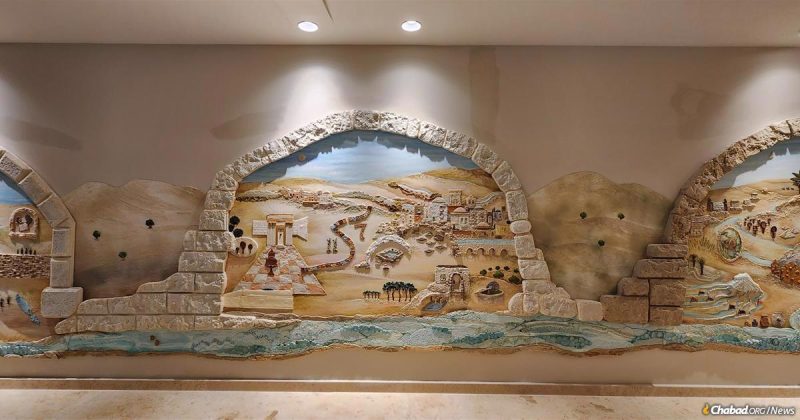
This Stunning 40-Foot Mural Greets Visitors at Mikvah Chana’s New Center in Tzfat
by Mendel Scheiner – chabad.org
Mikvah Chana in Tzfat has opened a new visitor center featuring a 40-foot mural that traces the spiritual history of mikvah through Jewish tradition. The Otzar Hataharah visitor center transforms the mikvah experience for local women and visitors to the mystical city in Israel’s north, offering education and inspiration alongside the mitzvah itself.
The mural, created by Chassidic artist Michoel Muchnik, depicts the journey of living waters from the Six Days of Creation through different eras of Jewish women’s spiritual resilience. The project took two years to complete in Muchnik’s Brooklyn studio and three weeks to install in Israel.
“The most challenging project I have ever worked on,” Muchnik said. “I am very happy that people are coming on these tours and learning through the art.”
The three-dimensional bas-relief combines paint, clay, crushed glass and metal, with Jerusalem-stone archways framing the work like gateways for the eye. An aqua-blue stream flows at the mural’s base, nourishing the composition. The piece spreads into three arches representing different eras of Jewish history, each depicting themes of Jewish women’s spiritual resilience—a sisterhood of living waters carried through generations.
“I learned a great deal about the meaning behind mikvah through the process,” Muchnik says.

Continuing a Legacy
Mikvah Chana was established in 1986 by Rabbi Aryeh Leib Kaplan and his wife Sarah, Chabad-Lubavitch emissaries sent more than a decade earlier by the Rebbe, Rabbi Menachem M. Schneerson, of righteous memory.
Blessed with a prodigious mind, Rabbi Kaplan had been one of the oral scribes who would memorize and transcribe the Rebbe’s lengthy talks on Shabbat and holidays before being handpicked by the Rebbe and dispatched to Tzfat. A short time earlier, a Chabad emissary asked the Rebbe whether he should hire the talented young man to help with Chabad activities in his city. The Rebbe responded, “I am taking him for myself.”
The Rebbe had a vision for restoring Tzfat to her former glory, writing of founding schools and yeshivahs, bringing in young families and immigrants, building a center for tourists, and expanding Chabad’s reach to build up the entire city, one of Israel’s four holy cities.
In a letter instructing the mikvah’s construction, the Rebbe wrote that it should be built with harchava, in abundance, underlining the word in his note. Over the years, the mikvah received various extensions, and a complete renovation was started five years ago.
In 1998, Rabbi Kaplan was tragically killed in a car accident near the Russian village of Lubavitch while traveling to attend the groundbreaking of a new Chabad center in Minsk, Belarus. He was 50 years old and was survived by his wife Sarah and nine children. His son Rabbi Chaim Kaplan and daughter-in-law Rivky have continued his work as Chabad emissaries in Tzfat ever since.

Cornerstone of Jewish Womanhood
The visitor center reflects a shift that began 50 years ago, in 1975, when the Rebbe launched his mitzvah campaign focusing on family purity. At that time, mikvah observance was rarely discussed publicly, and many Jewish families were totally unfamiliar with this foundational mitzvah.
By placing it alongside core mitzvot like tefillin and kosher, the Rebbe signaled that family purity was not a marginal practice but a foundational pillar of Jewish life. He urged communities to build and beautify mikvahs immediately, insisting they be attractive, clean spaces that Jewish women would feel proud to use.
“During the renovation, it became clear that the project wasn’t only about updating a building,” says Rivky Kaplan, director of Mikvah Chana. “There was an opportunity, almost a responsibility, to open something deeper. Tzfat attracts people looking for the neshamah, for the soul, and so our goal was to transform the mikvah from just another modern facility into a place of depth, soul and belonging—a place where women can participate in a mitzvah that connects to a larger story.”
Kaplan trained for two and a half years in the Halachic laws of family purity and became deeply passionate about sharing the beauty she had learned. Learning about the mitzvah across centuries, she felt a visceral sense of sisterhood and continuity.
“I read about a woman’s experience going to a mikvah in Baghdad over 1,000 years ago,” Kaplan says. “If you change a few details, that is literally me, today, in 2026.”
“I felt I needed to pay this forward,” she says. The goal is to inspire women to want to do mikvah, not to feel that it is a chore. “Show the color, the soul, the love inside this mitzvah.”

The mural tells the story of living waters through Jewish tradition. In the story of Creation, the Torah describes a single river flowing out of the Garden of Eden. The single river breaks into four, spreading out into the world. According to the Sages, the life-giving waters that once nourished Eden continue to flow through the pure waters of this world. To immerse in them is to touch a remnant of Gan Eden, a point of connection to the Divine.
The center includes a porch with a view of the Kinneret, the site associated with Miriam’s Well. Workshops are held there in which groups learn Jewish women’s history and then create art pieces to bring home.
Since Oct. 7, 2023, the mikvah has served women soldiers stationed around Tzfat, protecting the North of Israel. The mural includes depictions of the ancient battlefronts of Masada and Gamla, where archaeologists have found remains of mikva’ot—proof that families, farmers and rabbis fought for more than just their material freedom.
“I tell these women: no enemy can defeat a nation that fights not only for their bodies but for their souls,” Kaplan says.
An additional piece was commissioned in honor of Israel’s soldiers: two iron swords (the war was officially named Swords of Iron) crossed over a waterfall, symbolizing their connection to the living waters of the mikvah.
“There is a spiritual awakening happening as women seek connection, meaning and depth. As women, we need to realize that we are part of something much bigger,” Kaplan says. “Every woman needs to know that she is part of this story.”