
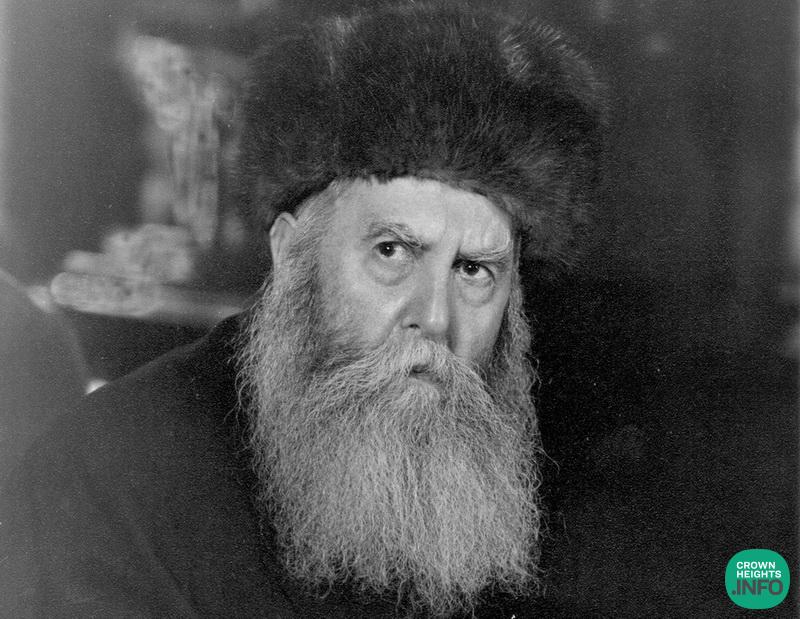
Weekly Story: The Rebbe’s (Shabbos) Farbrengens (Part 1 of 2)
by Rabbi Sholom DovBer Avtzon
Being that we are in the thirty-day preparatory period before Yud Shevat, I thought it is appropriate to write a brief review about the Rebbe’s farbrengens on Shabbosim, covering certain milestones or changes where the farbrengens were held, what time it began, when the Rebbe farbrenged and in the format the Rebbe farbrenged.
I could write it all up as one long essay. However, being that I feel it is very important to focus on the details and if I include everything in one week, some details may be overlooked. Furthermore, as I note, hopefully I will receive some feedback and have additional material to share with you all.
As always, your feedback and comments are greatly appreciated and welcome, especially on such a topic where additional information would be greatly beneficial to the public at large.
The first time the Rebbe Farbrenged in America[1] was on — three days after he arrived. However, the Rebbe did not desire to publicize his greatness, so while he responded to all that asked him questions in any aspect of the Torah, in general he wouldn’t talk in public.
The gabbai of 770 at that time was Mr. Meir Roth, he, as well as many of those who davened in the minyan, were orthodox Jews who lived in the neighborhood, but were not Lubavitchers. Shortly after he heard that the Rebbe’s Son-in-law farbrenged, and many of the chassidim and students listened to him speaking for a few hours, he mentioned to the Frierdiker Rebbe[2] his and the others who davened in 770 frustrations, that on Shabbos after davening none of Rebbe’s chassidim participate in the shuls kiddish. It is as if there is a separation between us. He then made the following request: Perhaps if the Rebbe’s son-in-law would participate and say something on the parsha or whatever thought he would like to share, the Rebbe’s chassidim and talmidim would also participate in the kiddish.
The Frierdiker Rebbe replied, here are three one-dollar bills as my participation, and when my son-in-law, would hear that I participated, he too would participate.[3]
Years later, the Rebbe noted that the Frierdiker Rebbe instructed him to farbreng every Shabbos Mevorchim.[4] So it is believed that the Frierdiker Rebbe instructed him then to farbreng on Shabbos Mevorchims.
So, when Mr. Roth mentioned to our Rebbe that his father-in-law the Rebbe gave him as his participstion, three-dollar bills for the kiddish and farbrengen, our Rebbe immediately agreed to farbreng every Shabbos Mevorchim. The first Shabbos Mevorchim that the Rebbe farbrenged was Shabbos Mevorchim for the month of Av, 5701. While there are over four hundred Shabbos mevorchims from then until Shabbos Mevorchim chodesh Shevat 5710, we only have a brief outline of three of those farbrengens.[5]
Until the Rebbe accepted the Nesius, he would join the kiddish almost immediately after davening. After accepting the Nesius, these Shabbos farbrengens would begin sometimes fifteen minutes after the conclusion of davening, sometimes thirty minutes and sometimes more. [The only other times that the Rebbe would farbreng were on Yomim Tovim, including Yud Tes Kislev and Purim.]
But that was good while the Rebbe would only farbreng on Shabbos Mevorchim, Yomim Tovim and Yomi Dipagra when they came out on Shabbos. As everyone knew that there would be a farbrengen, so the chassidim waited for the Rebbe to come out of his room and enter the small Beis Hamidrash. But when he began farbrengening on other Shabbosim a problem arose. Many of Anash lived in Brownsville and elsewhere outside of Crown Heights, and even if they davened Shacharis with the Rebbe in 770, they had no idea whether there would be a farbrengen and when the farbrengen will begin. And even on a Shabbos that there definitely would be a farbrengen, those who lived in Crown Heights didn’t know if they have time to go home and make Kiddish for the family or not.
The Rebbe then let it be known that the Shabbos farbrengens would begin at 1:30, no matter what time davening concluding.[6]
Then in the early Chofs (60’s) he began farbrengening on additional shabbosim. In the later part of 5624 (1964), he began farbrengening almost every Shabbos. Then the following year, it became every Shabbos, as it was in memory of his mother. Another aspect that changed that year was that the Rebbe began explaining a Rashi, and he focused on the first and final Rashi of the parsha.
That caused the farbrengens to conclude much later than before. So instead of the farbrengens ending at around 315 on a Shabbos afternoon, giving everyone time to eat and daven mincha, now, especially in the short winter Shabbosim, the farbrengens continued until shkiah (sunset). After the farbrengen everyone davened mincha, waited for maariv and after Shabbos they sat down to eat the Shabbos meal.
Quite often the Rebbe would note during the farbrengens, that being that there is a limited amount of time left, therefore, I will explain it briefly. Sometimes he would continue explaining it the following week or following farbrengen, while other times heel it remain as is.
Bezras Hashem, next week we will continue exploring additional changes in the farbrengens.
A Taste of Chassidus
Yehudah Atah Yudoocha Achei’cha יהודה אתה יודוך Torah Ohr 45A
The name Yehudah is as his mother said connected to the word of Oideh, which means give thanks, and also to the word moideh which is from the same root word, and it means admit. When a person admits to another that they are correct and I was wrong, that is a form of submission, and therefore when we say Moidim (the plural form of Moideh) in Shemoneh Esreh, we bow down, which is a demonstration of complete self-nullification.
So, in essence Yehudah represents the concept that the Jewish people/nation nullify themselves completely to Hashem, and that is the reason why all Jews all called a Yehudi, even though the majority of them are not from the tribe of Yehudah. That demonstrates that this quality of total submission to Hashem, is not unique to the tribe of Yehudah, but it also applies to every Jew.
In this maamar the Alter Rebbe is going to explain, that we are able to attain this level of Yehudah, when we daven Shemoineh Esreh. Being that we are then nullified, Shemoineh Esreh is said quietly, I am not pronouncing my existence and that is where and why we bow down to Hashem, four times.[7]
However, Yehudah was born after Reuvan, Shimon and levi. That teaches us that one can attain this exalted level after they experience the “journey and experience ” of Reuvan, Shimon and Levi.
So now let us explore their individual journey.
Reuvan is a compound of the two words Ri’oo Ben and he was given that name because as Rashi notes, Re’ooo mah bein binee [8]– See how wonderful my sons’ actions are, compared to his uncle Esau’s action. While the name Shimon was given because Hashem heard I am hated.
Chassidus explains that one of the major differences between seeing and hearing is that one sees something that is near to them, while one hears something that they cannot or did not see, as it is far/distant from them.
A person goes to see something because they have an interest in that item and are drawn to it. This is especially so if they decide to look intently at that thing. When one is drawn close to something that shows that the person has a desire or a love for that item.
However, when one feels that they are distant from something, that demonstrates that they are in a state of awe of that thing and feel completely inferior to it, as if to say, I am unworthy or uncapable of being united with it.
In one’s personal Avodah, this is the difference between the first parsha of Shema and the second one.
When one davens Shacharis and concentrates on how Hashem created everything, and everything is so insignificant and totally dependent upon Hashem for their very existence, that arouse a feeling and desire to come closer to Hashem. That is the theme and thought in the first Parsha of Shema, as it begins with the words, V’ahavta – and you shall love Hashem… with all your heart. And as commentaries explain, the reason rach individual should love Hashem is, because Hashem is giving you every moment of your life, the ability to live!
However, the more the person looks at the greatness of Hashem, the more they realize how exalted Hashem is and how insignificant and distant they are from Hashem, and that is the concept that is expressed in the second Parsha of Shema. There in the beginning it is noted, And if you will hear (listen), so we are now referring to a person who cannot see [as he sees that he is so far from Hashem], but can only listen, as they feel that they are distant, and that brings a feeling of awe of Hashem upon the person.
However, the person doesn’t remain in the state of “I am so insignificant, and who am I to come close?” But, to the contrary, that realization propels them to recognize how far their individual soul (Neshoma) is from its original place, and it fiercely wishes to return.[9]
That brings us to the aspect of Levi. As Leah expressed it, the name Levi means, to become attached, and that is what the Neshoma desires now, to become attached to Hashem. This concept of attachment is expressed in the tefilla of Emes, ViYatziv V’Nuchoin…, which is referring to the Torah, and through toiling in the Torah, until you understand it, that will connect and attach you to Hashem.
Yet, the person feels, that they are not worthy of elevating themselves to Hashem, as Dovid HaMelech expresses in Tehillim (Psalm 24), “Who may ascend the mountain of Hashem, and who may stand in His holy place? [Only one] who has clean hands and a pure heart…” But then the person realizes that Hashem send the Torah from the highest levels, to be intertwined in physical [and sometimes false] situations, so therefore, Hashem is saying to each one of us, no matter what level you are presently on, you can become connected and united with Me
This realization propels us to overcome our hesitancy and completely submit ourselves in complete submission, in Shemoneh Esreh, as is demonstrated through our bowing down in front of Him.
The way Yehudah expresses it in their daily life is, Yudchu B’oireifh Oi’yiveicha – your hand is at the neck of your enemy.
The enemy of a Jew’s Neshoma is the materialistic aspects of the world that every person must deal with. In simple words, we all have to eat, drink, earn a livelihood etc, meaning we involved with materialistic things. However, there are two ways a person deals with everything in their life. Either the thing is my primary objective, or it is something that I must deal with, but I do not care to focus on it more than is necessary.
[In Chassidic terminology the difference between these two approaches are called Pnimiyous HaRatzon and Chitzoniyous HaRatzon. As noted in previous installments, when Avrohom Shechted (slaughtered) three calves to serve his three guests, as he wanted to give each one a complete tongue, his objective was to serve these three special individuals. However, as a result there was going to be an enormous amount of leftover meat and bones.
Subsequently, his household help and even his dogs received a hearty meal, but that wasn’t Avrohoms Pnimiyous HaRatzon (primary objective). Or as Chassidus explains it, when one wants to give someone something, they deliver it and hand it to the recipient. However, when they are obligated to give them something against their will, they may toss it over their shoulder, as if to say, you can take it, but I am not giving it to you wholeheartedly.
This is what the possuk means, “Your hands in the neck of your enemies,” that the physical items that one is obligated to deal with and have the ability to allure and attach the person to become connected and immersed in acquiring physical pleasures, should be dealt with, as an unwanted obligation, without any feelings for it.
If a person succeeds in emotionally detaching themselves from these physical aspects, then they will succeed in becoming completely connected and one with Hashem. At that point our name is Yehudah, as the letter Yud at the beginning of the name signifies that we are constantly at this level, no longer just at this moment, as expressed by Leah.
Rabbi Avtzon is a veteran mechanech and the author of numerous books on the Rebbeim and their Chassidim. He is available to farbreng in your community and can be contacted at avtzonbooks@gmail.com
[1] The reason I wrote in America is because as is known that before the Frierdiker Rebbe left Riga to visit Eretz Yisroel and America, he instructed the Rebbe that he should farbreng that Tishrei in his stead
[2] Some say, this occurred when he visited the Frierdiker Rebbe while he was spending a few weeks in a health resort in Morristown, New Jersey. I have to verify the 2 or 3 time periods that the Frierdiker stayed at that health center for a few weeks each time.
[3] Mr. Roth’s son related that his father sold one dollar to a person who bought it on the condition that he will buy the mashke for the kiddish every Shabbos of that year. The second dollar was sold to the person, who promised to supply the mezones (cakes/crackers) for the farbrengens, while he kept the third dollar for himself.
[4] One of the times the Rebbe mentioned it, was when he expressed his being uncomfortable to farbreng when people were sleeping right in front of him. The Rebbe then noted that he can’t stop farbrengening as he was instructed by his father-in-law, the Rebbe to farbreng. However, perhaps I can fulfill that responsibility in front of a minyan and they would review it for those who were interested to hear.
[5][5] Rabbi Hodakov wrote the topics that the Rebbe spoke about in that first Shabbos Mevorchim farbrengen, and the Rebbe jotted down some points he discussed at two of the other farbrengens in his Reshimos. We don’t have transcripts of the other farbrengens.
I heard but have no way to verify if it is true or not, that Reb Zalman Shechter wrote down some of the thoughts that the Rebbe expounded upon during those farbrengens. If it is true, they were never publicized, and no one knows if those notes still exist.
[6] Concerning the time of 1:30 in the afternoon, there is a Sicha of the Frierdiker Rebbe where he notes, that one Shabbos after davening he held a farbrengen in his house and at exactly 1:30, his father the Rebbe Rashab entered and joined the farbrengen.
I was not able to find out exactly when this change occurred. Some say that on that Shabbos there was a bris, and the Rebbe informed the gabbai to announce the time, o that people would join bris and participate in the seudah. Others say that some chassidim mentioned this situation to the Rebbe’s mother, Rebbetzin Chanah, and she relayed their message to the Rebbe and therefore he made this change.
I also was told that the chassidim who lived in Boro Park expressed their situation, that even on a Shabbos Mevorchim, that they knew that there will be a farbrengen, being that sometimes it began fifteen minutes after davening, by the time they would come in from Boro Park, Bensonhurst etc., the farbrengen often had concluded.
[7] This is the reason why Leah said Now I will give thanks to Hashem, now means that there are times that I give thanks and admission to Hashem, but there are other times that a Jew may not be at that level. So when one davens Shemoineh Esreh, they are nullified, but until then they are not completely nullified.
[8] The reason we note this reason and not the reason that is expressed in the Possuk is, because, we are speaking about the person’s personal Avodah with Hashem. One’s Avodah is seen through one’s actions. However, the possuk sates that Hashem sees, so that is reflecting how Hashem will express (or reward the person with) His love to the person.
Author’s note: Additionally, according to the way the Alter Rebbe explains in ths maamar, it is the second stage of looking at Hashem, but this time it is with intensity, to the point that the person is mesmerized.
[9] This is what Chassidus often stresses that the definition of a Baal Teshuva, is not merely one who for whatever reason did not conduct themselves in the way of Torah and Mitzvos; but it also applies to a complete Tzaddik. The Tzaddik feels that he is so far from Hashem and has a fiery passion to come closer and closer to Hashem. As it says in the Zohar that Moshiach will bring a tzaddik to the level of a Baal Teshuva.









Mushkie
A few people were wondering:
“Reb Zalman Shechter” – is the title “reb” appropriate?
Mushkie
“his [Avrohom’s] household help and even his dogs received a hearty meal” – does it actually say that Avrohom owned dogs?!
Mushkie
During the years when there were farbrengens after davening, what did the chassidim who davened b’avoda do? Some were likely close to the start of davening. Did they continue davening and miss the farbrengen, or did they attend the farbrengen and leave the completion of davening till later?
Anonymous
(I am picturing the classic painting (Zalman Kleinman) of shabbos afternoon, 2 pm, one chosid has the still folded talis on his shoulder getting ready to daven, another chosid is completely under his talisman in deep contemplation…what would they do if there had been a farbrengen???)
Rabbi Shalom Avtzon
Concerning your questions which are all insightful, I will proceed in the order that they were asked. The reason I wrote Reb Zalman, is because once when he came to the Rebbe to receive a dollar, the Rebbe said to him … you are a Kohen, please bentch me. I don’t know how to search up that video, so I can’t say if the Rebbe said Zalman or Reb Zalman, but it is not for me to say what a person is. Could someone say for a fact that he did not do Teshuva, I don’t know if anyone could say that for a fact.
Concerning the question of whether Avrohom had dogs, I don’t know. However, the reason I wrote that the excess went to his dogs is because that is how Chitzoniyous HaRatzon is explained in numerous Maamorim. The example given is of a King who is making a feast that he makes in honor of his child’s wedding, and the bones go to the dogs.
The third question is a more difficult question and we will start with the earlier years. Then the farbrengen went on for around an hour and a half. So even if it wasn’t an expected farbrengen, the Oved had time to daven after the farbrengen concluded, and he had additional, new conceots to contemplate in his davening. Perhaps he wouldn’t have time to eat a complete Seudah.
However, once the farbrengens went on until mincha/shkia, which was common especially in the winter months, the question is stronger. I can tell you what my father, a”h, who was an oved, did. He was in the mikva shortly after six and began his preparation then. In essence the day did not begin at 10, when the Rebbe’s minyan began.
I asked a grandson of Reb Nissan Nemenow and he told me that when Reb Nissanwas in New York he would begin Shacharis every Shabbos at 8. This way he had five hours to daven before he went to his place for the farbrengen
Mushkie
Makes sense that an oved pre-planned, to start super early on shabbos mevorchim (after mikveh, learning chassidus and finishing whole tehilim!!) or on a yoma d’pagra. But what would they do for unexpected or unscheduled surprise farbrengens? Would they always start suoer early “just in case”, or would they be caught unprepared (and be firced to rush up davening – in the winter)?
Mushkie
A really silly question: The Rebbe’s “style” and “content” of farbrengen was of hardly any stories and focus on diversity Torah. In contrast, the Previous Rebbe spoke of many stories. The Rebbe defined to us a farbrengen. Yet when a rabbi mashpia farbrengs, the “style” is primarily stories and hardly any divrei Torah. Why is a chassidic farbtengen NOT in the style of the Rebbe’s farbrengens.
Mushkie
Someone in our group innocently asked if a “farbrengen” requires a minyan? When we replied that even two people can farbreng, she asked, the article says, thar Rebbe commented that “I can fulfill that responsibility [of making a farbrengen] in front of a minyan”. Why a minyan?
Mushkie
Final question. I heard (maybe incorrectly) that we DO have brief outlines of some of the Rebbe’s farbrengens before becoming Rebbe – in Paris, maybe. If that is true, it seems odd that the farbrengens in the USA before becoming Rebbe, we not recorded by anyone! Actually, how did audio recordings of Rebbe’s weekday farbrengens begin? Any audio recordings from Previous Rebbe? Facinating!