
JEM Releases New Film in “Rebbe’s Roadmap to Peace” Series
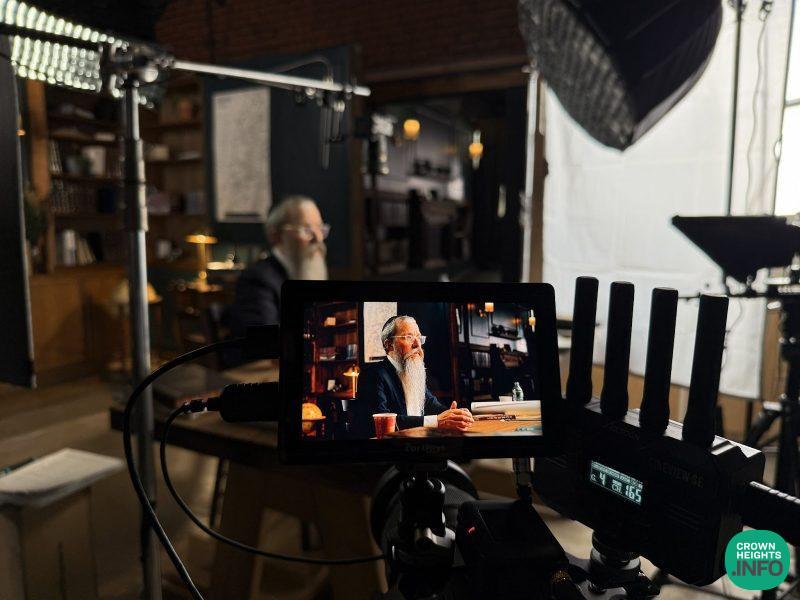
Too precious for standard shipping, a hand courier transported an airmail envelope from London to New York. The documents inside, yellowed and marked with blue ink, show the Lubavitcher Rebbe’s revisions to nearly twenty pages of English correspondence. Earlier this year, forty five years after being written, the original letters returned to New York. Their destination? A Brooklyn film set.
The film’s producers insisted on reading the originals during filming. For a film exploring a topic so consequential, the distinction mattered.
The documentary film, titled The 329 Paradigm: Torah’s Security Doctrine, unpacks a systematic framework for navigating Israel’s complex security dilemmas, as articulated by the Rebbe. Third in JEM’s “Roadmap to Peace” series, the film delivers the most comprehensive treatment yet of the Rebbe’s signature teaching on Israel’s security.
In correspondence spanning over two years, the Rebbe wrote to Britain’s Chief Rabbi, Lord Immanuel Jakobovits, laying out his opposition to the implementation of the Camp David Accords. The Rebbe had long urged Israel to reject territorial concessions, citing severe security implications. In these private letters, the Rebbe builds his case systematically—articulating a framework for evaluating policy decisions and applying it to Israel’s strategic reality.
Peter Kalms, a London businessman, served as the intermediary in the exchange. The Kalms family loaned the letters to JEM as the film’s centerpiece.
The inherent nature of Israel’s security challenges present competing pressures: security threats, international pressure, economic stability, among others. Navigating these dilemmas requires clarity on core interests and red lines.
As Israel faces intensifying threats on multiple fronts and the Trump administration presses for regional agreements, post-war decisions on security control, borders, and territorial concessions will shape Israeli security for decades.
The Rebbe’s framework, articulated in those letters to Lord Jakobovits, addresses the exact pressures Israel faces now—making the film’s subject, suddenly, urgently relevant.
At fifty-two minutes, the film employs multiple storytelling styles—archival video, line art, animated maps, and motion graphics—to clarify complex concepts. “The challenge was offering an accessible gateway for a broad audience while maintaining depth that scholars would appreciate,” said the film’s associate producer, Mendel Chein. “The solution was to show, not just tell.”
But one element proved distinctive.
“The Rebbe discusses Israel’s strategic reality in practical terms,” said Schneur Bergstein, the team’s graphic director, “so we thought it would be best to bring the viewer in.” Satellite footage, drone shots, and graphics create an immersive walkthrough of Israel’s geography—allowing viewers to see the strategic realities themselves.
The film is narrated by Rabbi Elkanah Shmotkin, JEM’s executive director, who founded Enduring Peace after October 7th, aiming to share Torah’s guidance on Israel’s security.
The letters have been returned to the Kalms family in London, but their journey to a Brooklyn film set ensures the Rebbe’s words continue to reach those who need them.
“The Rebbe believes that Israel can make the choices that lead to peace,” said Shmotkin. “This film brings that vision closer to fruition.”