The Details and Heroes of Bondi Beach
by Moshe New – chabad.org
Six minutes. One hundred meters. Thousands of people.
These are the dimensions of the Bondi Beach massacre. The inescapable geometry of terror that defined that horrific December 14 evening in Sydney, Australia.
Archer Park, where families gathered for Chabad-Lubavitch of Bondi’s “Chanukah by the Sea” on the first night of the festival’s eight nights, measures roughly 100 meters from its northern edge at Campbell Parade to its southern boundary at the Bondi Pavilion. One hundred meters from the western edge of the parking lot to the eastern edge where the park’s grass meets the sand. That was the killing field.
Thousands of people were celebrating Chanukah in that space. Jewish families, parents, children, grandparents. When two Muslim terrorists began shooting at 6:40 p.m., there was nowhere for the innocent celebrants to hide. The park is open ground, and the beach park’s Bondi Pavilion and parked cars offered some form of shelter to dozens, not thousands. The shooters and those who directed them there had planned well, positioning themselves on the footbridge above the parking lot, commanding clear sightlines across the entire park below. They knew what they were doing.

What follows is a reconstruction of those harrowing minutes and that one hundred-meter circle, based on eyewitness accounts, police reports, dashcam footage, and interviews with survivors and first responders. It is the story of what happens when people are trapped. When time compresses and space constricts and there is nowhere to go.
It’s also a remarkable story of human heroism, ordinary people—Jews and non-Jews—who, when confronted by the purest evil on earth, did the unthinkable: they ran towards it.
There was the elderly Jewish couple who tackled one of the gunmen, stopping him for a few precious moments before he could reach the main crowd. Rabbi Eli Schlanger, who walked toward death with his hands raised, appealing to the terrorist’s humanity to stop their murderous rampage. The elderly Chassidic Jew who ran towards one of the terrorists and threw bricks at him. The Muslim fruit seller who wrestled away a rifle near the footbridge. The woman who after being shot jumped onto a three-year-old she did not know to protect the child with her bleeding body. The Holocaust survivor who died shielding his wife. The great-grandfather who protected a friend in the open park. The medic who took a bullet to his chest while applying a tourniquet to an injured police officer.
Within the confines of those six minutes and 100 meters, that airless vacuum of evil, there was a choice to be made. Two armed adult males, a father and son fueled by an Islamist ideology of hate, chose death. The regular men and women below, those who ran to sacrifice themselves in the hopes of saving others.
This is the story of the heroes who chose life.
Approximately 6:40 p.m.
The silver coupe stopped on Campbell Parade. An adult male, later identified as Sajid Akram—the father of the murderous duo—stepped out and draped an ISIS flag onto the hood. His son Naveed exits from the driver’s side, and heads directly for a pedestrian footbridge that overlooks Archer Park. Father and son are each holding rifles in both their hands.
It’s summer. 85 degrees. The ocean breeze carries children’s laughter from the Jewish festival at Bondi Beach’s Archer Park. The menorah stands ready to be lit.
Boris Gurman, 69, and Sofia Gurman, 61, were walking along Campbell Parade when they saw the older terrorist stepping out of the car. The couple—married 34 years—were Jewish, but they were not there for the Chanukah event. Seeing the armed Sajid exit the car and the terror flag on the hood of the car, it seems they understood immediately what was going on. Without a moment’s hesitation, Boris and Sofia rushed at the man with the guns.

Dashcam footage captures what happened next: Boris tackled the older of the two terrorists just as he stepped out of the car. The elderly man grabbed at the murderer’s rifle; they struggled. Sofia was there, as always at her husband’s side, backing him up. Every second they fight is another second the terrorist can’t join his son, by now perched in their chosen elevated position above the park. Every meter they keep the gunman back is another meter between the shooters and the crowd. Boris manages to wrest the gun from the killers’ hands and appears to hit him with it.
Sajid then pulls out a second firearm and shoots.
Boris was executed right there on Campbell Parade, and Sofia struck down beside him. Drone footage taken later shows what appears to be her arm wrapped around him. Together in death as they were in life.
The pedestrian footbridge bordering Archer Park was 15 meters away from where the terrorists parked their car. Some 2,000 people were there celebrating Chanukah on its 100 meters of open ground.
The two men, if you could call them that, opened fire. And the six minutes of terror began.
In the Killing Field
The sound of gunfire in an open park is a scream that doesn’t stop. It echoed off the Bondi Pavilion walls to the south, bounced off parked cars, reverberating across 100 meters of grass with nothing to absorb it. The sounds, like the bullets producing them, were everywhere.
Watching the chaos unfold before them, the terrorists took pot shots into the crowd, transforming Archer Park into a killing field.
Parents pulled their children onto the grass, throwing themselves flat over them. Some scrambled for the Pavilion fifty meters to the south. Others ran toward Campbell Parade to the north, where the terrorists had already killed the Gurmans. Beach chairs overturn, strollers are abandoned. On the footbridge above the parking lot, the terrorists target one group and one group only: The Jews celebrating at “Chanukah by the Sea.” They make that clear by signalling other bystanders to stay back.
The older terrorist descends from the bridge and enters the park, while his son stays on the bridge. He spends some two minutes at ground level. Looking into the eyes of those he is murdering.

Yanky Super, a 24-year-old paramedic and volunteer on duty with Sydney’s Hatzalah emergency medical services, didn’t even hear a shot fired before he felt a bullet hit him in the back, collapsing his lung. Blood was streaming out of his mouth and nose. As he hit the ground, Super saw bullets whizzing over his head. He reached towards his shoulder mic to alert Hatzalah that he needed immediate emergency assistance, but it wasn’t there anymore. He disconnected the mic from the radio to hit the duress button.
“I’m bleeding…I can’t move. I’m on the ground, I can’t move,” Super says in the recorded emergency call, speaking weakly.
Even as the bullets were still flying, from his vantage point on the grass by the entrance of the park, Super could see the cars of his colleagues arriving to answer his call for help.

Standing near the stage at the center of Archer Park, equidistant from every boundary of this 100-meter circle, Chabad of Bondi’s Rabbi Eli Schlanger—who moments earlier had been wrapping tefillin with someone—saw one of the gunmen pause to reload.
Schlanger—41 years old, father of five including a two-month-old baby—raised his hands above his head. Stepping down from the stage, he walked north toward the footbridge. Surely aware of the danger he was further placing himself in with each step he took towards the terrorist, the young rabbi pushed forward anyway.

Survivors say he walked towards the terrorists with hands raised, drawing their attention to him, and pleading on behalf of his family and community: “Please, stop!” he yelled. “No more!”
One of the gunmen on the footbridge raised his reloaded rifle and fired.
Schlanger fell approximately 35 meters from the stage. Behind him, hiding near a food station, his wife Chayale was grazed by a bullet in her back. Their two-month-old baby Shimshy took shrapnel to his leg.
Rabbi Schlanger, hoping to appeal to the humanity that lies within even the darkest of souls, managed to distract the terrorists for moments. For others taking cover in that 100 meter killing field, those seconds meant the difference between life or death.
The Middle Minutes
The three Sydney police officers on duty saw the shooters on the footbridge, heard the gunshots, and saw the people falling. They engaged the gunmen, with two of the officers being shot, one of them taking a bullet to the head.
Twenty-year-old rabbinical student Leibel Lazaroff, originally from College Station, Texas, where his parents run a Chabad center for students at Texas A&M, crouched over a critically injured police officer, using his own shirt as a tourniquet.

Lazaroff pleaded with the injured policeman—who was shot in his dominant hand—to use his other hand to continue shooting at the terrorists. The policeman refused. Lazaroff, who is licensed to carry a firearm in his native Texas, then begged the officer to allow him to take the gun and try himself. That’s when a bullet slammed into his abdomen, with shrapnel piercing his thigh. Despite everything he continued to apply pressure to the policeman’s wound until reinforcements arrived.
Somewhere in the chaos, three-year-old Gigi was separated from her parents. Jessica Rozen, a mother attending “Chanukah by the Sea” whose two children were nearby with her husband and mother-in-law when the shooting began, saw the wandering little girl and threw her body over her on the grass. Rozen felt a bullet tear into her, but she didn’t move off of the child. She knew she was the only cover the little girl had.
Nearby, another woman lay on the ground. She’d also been shot, and was terrified for her two young children with her. Not far from them was14-year-old Chaya Dadon, who, spotting the situation, abandoned the bench under which she’d taken to shield the children. Seconds later, Chaya was shot in the leg.
Alex Kleytman, an 87-year-old native of Ukraine, was near the eastern edge of the park together with his wife, Larisa. Alex had survived the Holocaust, arriving decades ago at what he thought were the safe shores of Australia.
As bullets rained down upon them, Alex raised himself over his wife, the shots heading at her hitting him instead. He passed away on the grass near the beach, meters from where Boris and Sofia fell on Campbell Parade.
Tibor Weitzen—78, the beloved candy man of the synagogue at Chabad of Bondi—was elsewhere in Archer Park and moved to protect a family friend, Edith Brutman. Placing himself between the friend and the bullets coming from above, he fell while protecting her. Brutman later succumbed to her wounds as well.
Others murdered included Dan Elkayam, a French Jew living in Sydney; one of the event organizers, Yaakov Levitan; 10-year-old Matilda, whose mother saw one of the terrorists deliberately take aim at her young daughter and strike her down; retired police officer and event photographer Peter Meagher; and Slovak Marika Pogany.
6:43 p.m.: Fighting Back
Syrian-born Muslim Ahmed al-Ahmed was standing near the northern edge of Archer Park, perhaps 25 meters away from the footbridge where the gunmen command the high ground. He knew civil war from his birthplace, but here, in Bondi, on a Sunday evening, the 43-year-old father of two had just come for coffee. The terrorists were not aiming at Ahmed, either—he could have turned the other cheek. Instead, he jumped into action, creeping towards one of the shooters using parked cars for cover. He focused on the older terrorist who was walking around, busy picking off people hunkered in the bloody grass of Archer Park.
By now, the terrorists had been shooting for three minutes and 20 seconds.
The collision happened near the footbridge, as Ahmed charged the unsuspecting terrorist from behind. They hit the pavement beside the parking lot, the rifle between them. Rolling in the narrow space between parked cars and the park’s edge, Ahmed had his hands on the weapon, while the terrorist fought back.

Ahmed managed to wrest the rifle from Sajid Akram’s grip and then pointed it at him. The terrorist backed away, crawling on his back and then ran back to the bridge. His son was still there, firing away. Seeing what Ahmed had done, the younger terrorist swung his rifle down and fires from the elevated position into the narrow space beside the carpark.
The bullets punch into Ahmed’s shoulders, then arm, the sounds echoing through the parking lot. He’s hit four times, then five. But the first rifle—the one that had been fired so many times into the innocent crowd—was no longer in the terrorist’s hands.
Reuven Morrison was near the western edge of Archer Park, near the parking lot, when he saw Ahmed’s tackle. The Soviet-born Chassidic Jew had fled from the antisemitism of his birthplace some 50 years earlier. Camera footage later revealed that Morrison had immediately run towards the terrorist roaming the park, likewise making himself a target so his loved ones and fellow community members had more time to flee.
By this point he was only 20 meters away from where Ahmed had wrestled the older terrorist’s gun away. Morrison grabbed a brick and ran at the disarmed attacker, throwing it with a force that belied his 62 years. He then ran back toward the rifle Ahmed had removed from the terrorist, which now lay near a tree. No cover. Making himself visible. Making himself large. Drawing fire.

Morrison picked up the rifle and attempted to shoot the terrorists. The gun wouldn’t fire. Whether because it was empty or jammed is still unknown.
The gunman on the footbridge tracked Morrison across the grass, aimed and fired. Morrison fell in the open park, perhaps 30 meters from Ahmed, and 40 from where the Gurmans were killed on Campbell Parade.
Every second the shooter focused on Morrison was a second he wasn’t firing into the families huddled against the Pavilion wall to the east, or the people sheltering behind cars to the west. Multiple times throughout the massacre, Morrison has forced the gunman’s attention onto him, and away from the crowd.

At this point there was still no meaningful police response or even crossfire. No support, and yet no end in sight. Only ordinary, everyday people, who at the very moments they were needed, had unthinkingly transformed into heroes.
6:46 p.m.: The Worst Quiet
Hatzalah volunteer Mendy Litzman heard the calls for help coming in over the radio. He was in another part of Bondi, not at the beach, when he and his fellow volunteer medics drove toward what Litzman described later as a “warzone.”
When he entered the scene, the shooting was going on, the terrorists making their final stand side by side on the bridge.
“Very chaotic,” he’d later say. “Everyone screaming, ‘Mendy, help me, help me, help me.’”
He moved from victim to victim. This one at the Pavilion, fifty meters south, that one near the footbridge, twenty meters north. Another in the parking lot. The concentration of casualties in such a small space meant he could reach them quickly but it also meant he and the other medics were constantly within range. Every step across the park was a step in the open.
From Tamarama Beach, one kilometer south—outside the bubble—lifeguard Jackson Doolan heard the commotion. He grabbed his equipment and ran north along the beach. Other lifeguards followed, arriving barefoot and heading straight into the circle. One pulled a swimmer from the water 70 meters from the shooting. Others, using their rescue buggies for cover, moved through the park treating victims.
Chayale Schlanger cried to her husband to wake up, to “make a miracle.” She begged emergency responders to bring life back to him. To administer CPR, to do something. The geography forced them to work exposed, but they worked anyway.

At approximately 6:46 p.m.—six minutes and 10 seconds after the first shots, after thousands of people have been trapped in 100 meters of hell with nowhere to run and nowhere to hide—additional police officers finally arrive.
The gun battle between them and the terrorists took place across the 100 meters of the park. Police firing up at the footbridge, the terrorists firing down into the park, more than 50 shots in all. Police fire from Detective Senior Constable Cesar Barraza killed the older terrorist on the footbridge. The second one was critically wounded.
The shooting finally stopped.
But the silence after was almost worse than the noise. In the silence, there was only the aftermath.
The Hatzalah volunteers, the first emergency responders to arrive at the deadly scene, as well as the lifeguards who soon joined them, worked on the victims. It was during those moments that Mendy Amzalak, a first responder with Hatzalah who’d rushed into the carnage, discovered that his grandfather, Tibor, was among the murdered. More difficult news would follow.
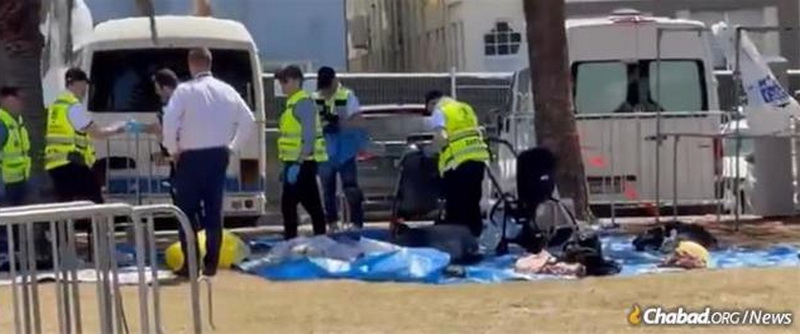
The sun was setting over Bondi Beach as emergency vehicles began lining Campbell Parade, helicopters circling overhead. In just six minutes and 10 seconds, the world had been forever altered.
Thousands of people had come to Archer Park, and 15 would never leave. Forty-two were wounded. But hundreds more are certainly alive because of the bold actions of regular-day heroes.
The menorah Rabbi Schlanger had prepared to light at “Chanukah by the Sea” was not kindled that first night of Chanukah, but the light that shone within the souls of that horrific evening’s heroes continues to burn bright.

It was the master commentator Ramban who wrote: “The candles of Chanukah will never be nullified.” The Rebbe, Rabbi Menachem M. Schneerson, of righteous memory, explained that while outside decrees or the like could at times prevent Jews from kindling their menorahs in public, they could never do so within their homes.
For “the concealment of G‑dliness which characterizes exile, and in a larger sense characterizes our material existence as a whole,” the Rebbe explained, “cannot prevent the light of Chanukah from shining.”
To learn more about the souls lost during the Bondi Chanukah Massacre, click here. May their memory be for a blessing.