A Marriage Proposal, a ‘Trash-Mountain,’ and the Transformative Light of Chanukah
by Mendel Scheiner and Jacob Scheer – chabad.org
On a freezing December night in 1986, a young rabbi stood in a Baltimore suburb trying to light a seven-foot wooden menorah he’d built himself. He didn’t know it then, but this simple act would transform not just his community, but generations of Jewish families for decades to come.
It was the seventh night of Chanukah when Rabbi Hillel Baron, a young Chabad-Lubavitch emissary who had recently moved to Columbia, Md., with his wife, Chanie, organized the county’s first-ever public menorah-lighting. At that time, there were no readily available mass-produced menorahs available, so Rabbi Baron constructed his own. With a jacket to protect him on that frigid winter night, Rabbi Baron was kept warm not just by the menorah’s flames, but by the palpable sense of Jewish pride that the attendees were feeling.
One of those participants was Chana Gittel Deray, a local resident who was deeply moved by what she saw.
“The Barons were so young then, and they were desperately trying to light those torches and keep them lit. But there was something about it that touched a very deep place inside,” recalled Deray, who remembers the lighting’s impact on her and the others present. “You could’ve been there by yourself and not known anyone, but the guy standing next to you at that point just became your brother and you’d do anything for him.”
For Chana Gittel, those menorah lightings—and the warmth of the young Chabad emissary couple—became the spark that ignited her own journey back to Judaism. Although not observant at the time, the combination of the Barons’ genuine care for every Jew and commitment to Jewish tradition created a connection that pierced through that cold winter night.
“Their family became our family,” she says. “There was something that united us all as we stood there watching the menorah. Everything else just kind of shrank into the background, and there was just a very powerful feeling of connectedness, of oneness.”
That connection proved transformative. Chana Gittel became a ba’alat teshuva, growing in her observance and raising nine children, several of whom are now grown and serve as Chabad emissaries themselves. Today, she writes on Jewish topics (including public menorahs), teaches a course called “Finding Joy in the Chaos,” helping young Jewish mothers ground themselves in the importance of their role, and speaks at workshops across the country about finding purpose and joy in Jewish motherhood.
Passing on the Torch of Leadership
Chana Gittel’s family wasn’t the only one transformed by those early menorah lightings. Four of the Barons’ children are now Chabad emissaries in the county, carrying forward their parent’s work and bearing the torch of leadership. Together with their spouses, they’ve expanded what began as a single handmade menorah into over a dozen public menorahs on display around the county, with public lightings in five local communities.
Among them is Rabbi Yanky Baron, who co-directs Chabad-Lubavitch of Ellicott City with his wife Leah. He has seen firsthand how these public Chanukah displays touch new souls.
“Each new menorah we put up is like a magnet that attracts people we’ve never seen before,” says Rabbi Yanky. “They come to the lightings and connect in a very real way.”

Last year, at one of Rabbi Yanky’s Chanukah lightings, the menorah’s magic took on a new dimension.
While steam rose off the hot latkes in the cold night and kids danced and spun in dreidel costumes, Rabbi Yanky shared a Chanukah message. During his speech, a young Jewish man in the crowd suddenly dropped to one knee and proposed to the young Jewish woman next to him. She said yes.
More than the spontaneity of the moment, what surprised Rabbi Baron the most was that he had never met this couple before. “The guy had planned to propose at a restaurant in the nearby Columbia Mall, but had driven past the Chabad menorah lighting and decided to stop on the way,” Baron recalled.
Standing there, watching the menorah flames glow in the night sky, the young man became emotional and realized it wouldn’t be the same anywhere else.
“The location of the proposal wasn’t coincidental—it was the result of the Rebbe’s campaign to display the light of Chanukah in every possible area that a Jew might see it. The menorah’s lights warmed up their Jewish souls.”
1973: The Rebbe’s Call
The magic Rabbi Baron describes, and the transformation that Chana Gittel and her family experienced, began with a single directive more than 50 years ago.
In 1973, the Rebbe—Rabbi Menachem M. Schneerson, of righteous memory—established the worldwide Chanukah campaign to promote observance and awareness of Chanukah.
The Rebbe emphasized that more than simply a mitzvah or a spiritual act, when a menorah is kindled, literal light emanates from it. The illumination is immediately visible to passersby—a profound sign of the message of Chanukah that a little light dispels much darkness. Soon after the Rebbe gave this directive, Chabad yeshivah students began standing on street corners handing out tin menorahs.
The following year, Rabbi Avraham Shemtov, director of Chabad of Philadelphia, lit the world’s first public menorah outside Independence Hall. That first menorah-lighting sparked a movement, and Chabad began to install public menorahs in parks, in public spaces and in highly visible spots to spread the message of Chanukah and as potent symbols of Jewish pride.

Photo by Richard Marc Sakols. Corner of Allen & Grand Streets. 1975. Pentax SLR Film. Lower East Side, 1975: Portrait of a Changing Jewish Neighborhood. 3 Dec. 2024 – 23 Nov. 2025. Museum at Eldridge Street, New York.
At the time, celebration of Chanukah was a private ritual done in homes and synagogues. In the decades since, Chanukah has become a holiday celebrated in town squares and city centers across the country, and in front of iconic global landmarks, which today include the White House, Fifth Avenue, the Eiffel Tower and many others.
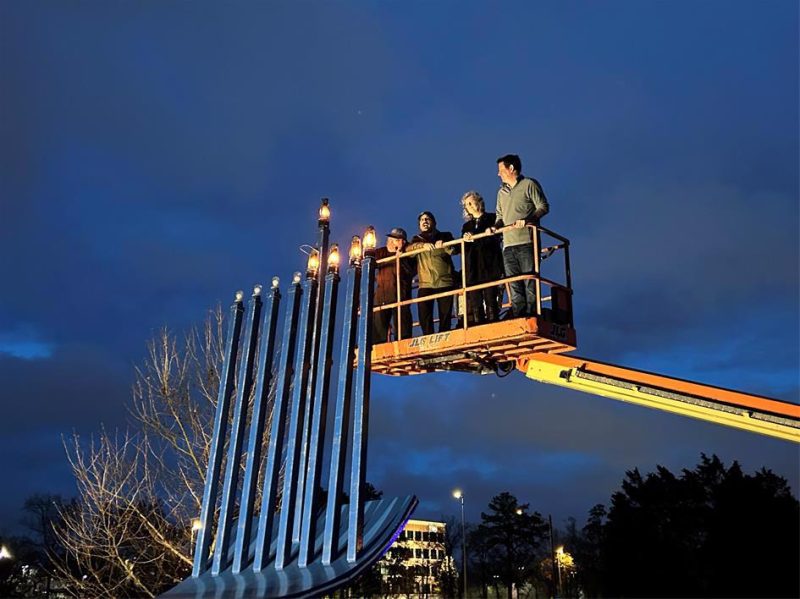
One early iconic public menorah was erected in Virginia Beach, in 1979. That year Rabbi Aron and Rychel Margolin were appointed Chabad emissaries to Tidewater, a small coastal community encompassing five cities in Southeast Virginia. The Margolins searched for the ideal spot to display a giant menorah and settled upon Mount Trashmore—a landfill that was transformed into a much-loved 165 acre public park in the early 1970s. The beautiful, stylized menorah overlooks I-264, making it visible to every car passing below, the site upon which it sits eventually becoming known as “Chanukah Hill.”
Stanwood Dickman was in his mid-40s when he attended the first menorah-lighting at Mount Trashmore Park in 1981. It was unlike anything he’d experienced. Tidewater was a small Jewish community with only a few thousand Jews, and menorahs were few and far between. Now 90, the memory of that first lighting remains vivid.
“It was wonderful,” Dickman recalls. “This was the first opportunity for all the Jews to get together and to share a menorah like that and honor our Judaism.”
His daughter, Ray Alyssa Rothman, was in her teens at that first lighting. She recalls fondly the delicious jelly doughnuts and hot chocolate they served, as well as the vibrant dancing, upbeat live music, and, of course, the giant 30-foot tall menorah.
“It was a novelty to see a public menorah at that time,” Rothman recalls. “Let alone on the highest point in Virginia Beach.”
However, what stuck with her most was the immense feeling of Jewish pride it gave her and the community.
“It was such a meaningful memory when it first started in the community and wonderful to see that it continues year after year.” she said.
Now a commercial real estate broker in Atlanta, Rothman is a leader in Atlanta’s Jewish community and attends Chabad of Dunwoody’s public menorah-lightings with her children. Ray described the impact the menorah-lightings had on her and the community in an Atlanta Jewish Times op-ed, writing: “The initiation of this candle-lighting was a catalyst that helped galvanize the Tidewater Jewish community and strengthen our Jewish identity.”
More than 40 years later, the Mt. Trashmore menorah lightings remain an annual Chanukah highlight for the Jews of Tidewater. Hundreds gather each year, filling the park where Dickman and Rothman once stood. The iconic menorah graced the cover of And There Was Light … : A Photographic Chronicle of the Public Menorah Celebrations Sponsored by Chabad-Lubavitch around the World, published in 1987.

“What makes the lightings so special is that they’re multi-generational,” says Rabbi Levi Brashevitzky, who along with his wife, Rashi, directs Chabad of Tidewater and his in-laws, the Margolins. “People want to show their kids the beauty of Judaism. To show their children that there is proud Judaism in public to connect to.”
This year, for the first time, Mount Trashmore’s menorah-lighting will be hosting a “Chanukah Wonderland” with a real working Chanukah train for kids to ride on, as well as a 50-foot “gelt drop,” and a car-menorah parade.
Ray Rothman got a chance to return to Mt. Trashmore this past Chanukah with her 90-year-old father and her three children. The nostalgia washed over them—the familiar Chanukah treats and delicacies, the enormous menorah, and the palpable sense of community.
Dickman reflected upon having come full circle, from bringing his children to the menorah lighting more than four decades ago to continuing the same tradition with his grandchildren. “It’s quite an honor,” he says, his voice heavy with emotion. “To share that memory with my daughter and now her children. To share the happiness of being Jewish and celebrating our faith. I hope my grandkids will remember it and talk to their children about it.”