
‘Complete Tanya’ Fulfills the Rebbe’s Vision from a Century Past
by Motti Wilhelm – chabad.org
In 1516, a non-Jewish printer named Daniel Bomberg published a work that would reshape Jewish learning for centuries to come. His Mikraos Gedolos placed the Torah text with its classic and super commentaries on the same page, a revolutionary format that quickly became the enduring standard for Torah study.
More than five centuries later, and roughly seven decades after the Rebbe—Rabbi Menachem M. Schneerson, of righteous memory—articulated a vision for such a project, a groundbreaking new series seeks to do that for the Tanya, the foundational work of Chabad Chassidism.
As the centerpiece of Chassidic philosophy and study, the Tanya, authored by the founder of the Chabad-Lubavitch movement, Rabbi Shneur Zalman of Liadi (known as the Alter Rebbe), and first published in 1796, has been explained and illuminated by his successors, the Rebbes of Chabad. Some of their teachings take the form of direct commentaries; far more often, however, their insights are woven into Chassidic discourses whose primary themes may lie elsewhere, yet contain profound explanations of the Tanya embedded within them.
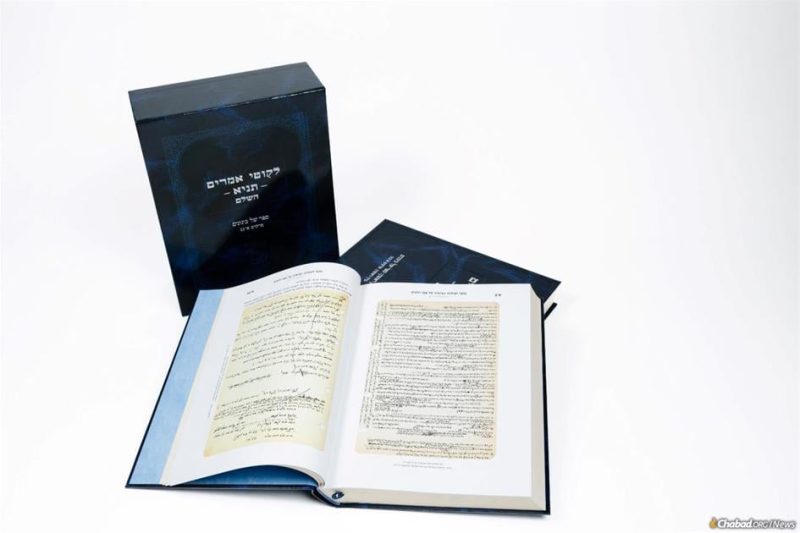
This makes the publication of the new Tanya HaSholeim, or the “Complete Tanya,” an event of historic proportions. Release of the large-format, two-volume set—in time for 19 Kislev, the anniversary of Rabbi Schneur Zalman’s release from Czarist imprisonment in 1798—is the culmination of a 20-year effort by the scholars at Vaad Hanachos B’Lahak (Lahak) to gather, edit, and present the explanations of all seven Chabad Rebbes on the Tanya in one unified, accessible work. Remarkably, that is only part of what the series contains.

Over Seven Generations
Ever since the Tanya was first printed 229 years ago, it has been studied and taught throughout the Jewish world. As a profound work that introduces the deepest concepts of Jewish philosophy while simultaneously serving as a practical guide to personal, heartfelt Divine service, it is regarded as the seminal text upon which the entire corpus and worldview of Chabad Chassidism is built and a cornerstone of broader Jewish thought.
Across the six generations that followed, each Chabad Rebbe expanded upon the ideas set forth in the Tanya within their own teachings. Some, such as the third Rebbe, known as the “Tzemach Tzedek,” wrote direct commentaries on the Tanya. Far more often, however, their insights appeared indirectly, embedded throughout the more than 500 volumes of Chabad teachings.
These teachings, known as ma’amarim, explore core concepts of Chassidic thought, frequently linked to the Torah portion of the week or to the spiritual themes of the calendar. Scattered across this vast literature are thousands of passages that elucidate, develop and clarify the words of the Tanya, sometimes at great length, sometimes only in brief and in passing.
Ninety-five years ago, in 1930, a young man in Berlin began a project that would ultimately reshape the study of Tanya. That young man, the Rebbe, was by then the son-in-law of the Sixth Rebbe—Rabbi Yosef Yitzchak Schneersohn, of righteous memory, whom he succeeded in 1950. While in Berlin pursuing university studies, the Rebbe remained deeply involved in many aspects of the Sixth Rebbe’s communal work, and it was during this period that he began compiling a super-commentary on Tanya, which he titled “Sources, Glosses, and Brief Notes to the Tanya.”
About a decade later, following his escape from Nazi-occupied Europe and his arrival in America, where his father-in-law had re-established his Chassidic court, the Rebbe began formulating a broader and more ambitious vision. Referenced in several letters from 1943 and onward, this vision was fully articulated in 1954 in the Rebbe’s introduction to his appendices and index on the Tanya:
In the forthcoming complete edition of the Tanya now being prepared for publication, the Tanya text will appear in the center of the page, and surrounding it will be: sources; a concise commentary; and selections from the writings and manuscripts of our Rebbeim that elucidate the words of the Tanya … .
Despite the significant work already invested in the project, this “Complete Tanya” never reached publication. During this period, the Rebbe was rapidly expanding Chabad’s activities worldwide, with his address at 770 Eastern Parkway increasingly becoming the central address for countless individuals seeking guidance and direction, either in person or via correspondence. The Rebbe likewise undertook many new Torah publication projects. These pressing demands left him with less and less time to devote to certain long-envisioned scholarly projects, including the Tanya HaSholeim.

Partial Fulfillment
Still determined to see the Chabad Rebbes’ commentary on the Tanya gathered in one place, in 1971 the Rebbe instructed Rabbi Aharon Chitrik, a Chassidic scholar who served as head of Otzar HaChassidim, Chabad’s primary editorial body, to undertake the task. Chitrik was charged with combing through the voluminous published Chabad teachings and extracting every commentary relating to the Tanya, which he did, publishing the material in individual booklets.
Around the time the first booklet, on the opening chapter of Tanya, was released, a group of individuals wrote to the Rebbe asking him to publish the complete edition he had outlined in his 1954 letter. The Rebbe replied:
“Seeing that the full plan cannot be implemented at present due to the many pressing responsibilities, it is therefore fitting to at least begin with something of this nature,” he wrote, explaining that although there was not sufficient time to bring the full project to fruition, a partial beginning, in the form of Chitrik’s compilation, could nevertheless be made. “Accordingly, the first installment, Tanya, Chapter 1 with sources, etc., has just now been issued and is enclosed here.”
After two decades of work, the booklets were reissued as a unified set.
At the same time, various other commentaries on Tanya were being published. Some offered a running explanation, such as Shiurim B’Sefer HaTanya, which were based on Rabbi Yosef Wineberg’s Yiddish classes on Tanya broadcast on WEVD radio, as well as its 1980s English adaptation, Lessons in Tanya. Others were more in-depth analytical works. All of these significantly enriched the study of Tanya. Yet none matched the scope or vision of the Rebbe’s original plan.
Then, in 1995, a year after the Rebbe’s passing, a remarkable discovery was made: the commentary the Rebbe had begun as a young man in Berlin still existed in manuscript form. It was found together with other handwritten Torah novellae and correspondence, eventually published as Reshimot. The Tanya commentary was published separately under the title Mareh Mekomos, Hagos ve’He’aros Ketzaros le’Sefer Shel Beinonim, the original Hebrew-language name the Rebbe had given it. Issued in installments over several years, it was accompanied by a compilation of the Rebbe’s teachings on Tanya, drawn from his ma’amarim, talks, and letters.
At the forefront of this publishing effort stood Rabbi Chaim Shaul Brook, director of Lahak. Brook had been involved in publishing the Rebbe’s teachings since the 1980s, when he helped produce the complete collection of the Rebbe’s talks from 1950-1981 in the Sichos Kodesh series. He also organized the publication framework for the Rebbe’s ma’amarim, arranging for these discourses to be prepared and submitted to the Rebbe for editing on a regular basis.
In the 1990s, he became the head of Lahak, which was dedicated to publishing authoritative Hebrew editions of the Rebbe’s talks.

“It always bothered me that the Rebbe’s vision of a complete Tanya had never come to fruition,” Brook explained. “The Rebbe laid the foundation and even encouraged others to produce partial versions of the larger project, but the full vision was never realized.
“So while we were publishing this remarkable treasure, the Rebbe’s handwritten commentary on Tanya, that vision was always in the back of my mind.”
Twenty Years and a Team of 30
That vision came rushing to the forefront several years later. After most of the Rebbe’s handwritten commentary on Tanya had been issued as booklets, it was decided to re-edit and republish the material. Initially, the plan was simply to add more of the Rebbe’s teachings and perhaps update the format. But at that point, Brook realized he had an opportunity to finally fulfill the Rebbe’s original vision.
It would be a mammoth undertaking. Dozens of additional volumes of Chassidic teachings had appeared in the years since Chitrik had first published his compilation on Tanya. Combing through all of them, and rechecking the earlier volumes, would require an entire team, even before taking into account the editing and production costs.
Brook approached philanthropist George Rohr, a leading supporter of Chabad activities worldwide, and presented the idea. Rohr agreed to provide a very generous initial gift in memory of his late father, Mr. Sami Rohr, and the project was launched.
A team of 20 scholars, headed by Rabbi Aharon Leib Raskin of the Otzar HaChassidim editorial staff, began studying and extracting relevant teachings beginning with Rabbi Schneur Zalman’s own writings not in Tanya itself, subsequently going through all seven generations of Rebbes. They also incorporated the commentary of Rabbi Levi Yitzchok Schneerson, the Rebbe’s father. Written in the margins of a Tanya, his notes were composed during his Soviet-imposed exile in the remote region of Chi’li, Kazakhstan. Lacking both paper and ink, he recorded his Torah insights in the margins of the few holy books in his possession, using homemade ink that his wife, Rebbetzin Chana, produced by boiling herbs and berries.
In consultation with Rabbi Yoel Kahn, the Rebbe’s chief oral scribe and preeminent Chassidic scholar, a key decision was made: rather than simply copying and pasting passages from existing volumes, the material would be reworked to highlight the commentary each passage provides on Tanya. Kahn served as the project’s founding chief editor together with Rabbi Dovid Feldman, chief editor of the Toras Menachem series of the Rebbe’s talks. They were joined by Rabbi Yisroel Shimon Kalmenson, who has compiled the references to the Rebbe’s talks for decades and did so here as well, and by chassidic scholar and veteran teacher Rabbi Elimelech Zweibel, who reviewed each chapter.
Kahn also served as the project’s founding chief editor, later handing the role over to Rabbi Mendel Kaplan of Detroit.

This stage of the project took no less than 18 years. During that time, another remarkable discovery emerged. Over the years, the Rebbe had jotted down insights on Tanya on loose-leaf pages and scraps of paper, notes that had never been seen before. They were uncovered in the Rebbe’s private home on President Street in Crown Heights, adding yet another layer to an already monumental undertaking.
With this major stage of the Rebbe’s vision complete, two additional components still remained: the sources and the concise commentary. The sources were drawn from the Rebbe’s handwritten notes, the Tzemach Tzedek’s glosses on Tanya, and other supplemental material. For the concise commentary, it was decided to adapt Shiurim B’Sefer HaTanya, the work based on Rabbi Yosef Wineberg’s radio classes, which had been edited by the Rebbe at the time. The lengthy material was carefully pared down to extract only the running commentary on the Tanya, which was then incorporated into the project.
This source yielded additional treasures as well. While editing Rabbi Wineberg’s classes, the Rebbe had written his own insights, emendations, and even extended commentaries on the Tanya. While some of these were included in the original Shiurim B’Sefer HaTanya with notes identifying them as coming directly from the Rebbe, others had only been incorporated into the radio classes. Still others had never been published in any format.
Brook and Kaplan went through Wineberg’s original manuscripts with the Rebbe’s edits line by line, gathering every comment, nuance, and note from the Rebbe that touched on Tanya. They were joined by Rabbi Mendel Cohen, a mentor and teacher at Yeshivat Ohr Elchonon Chabad in Los Angeles, who has spent more than a decade studying these manuscripts and contributed additional insights. All of this material was incorporated into the “Commentary From the Rebbeim” section of the new Tanya project.

Accessible in Every Way
As the work on the first section of Tanya, Likkutei Amarim, neared completion, bringing two decades of effort to fruition, Brook made another bold decision. Determined to make the new set as accessible as possible, and to place the Rebbe’s envisioned edition of the Tanya into as many homes, study halls, and libraries as he could, he resolved that the set would be sold at a drastically subsidized price of $18. This was below the actual printing cost, to say nothing of the enormous time, effort and financial investment that had gone into creating it.
“This set could easily have sold for over $100, and no one would have batted an eyelash,” said Rabbi Yisroel Zilberstrom, editor at Lahak and a member of the Tanya Hasholeim Institute. “We’re talking about two decades of work, more than 30 team members and two beautiful, large volumes.”
“The total cost of 20 years of editorial work amounted to several million dollars,” shared Brook, “and under regular circumstances it would be very difficult to secure the funding even before any subsidized sales.
“I traveled to the Rebbe’s Ohel every single day for an entire year and made a pledge that if I succeeded in obtaining the full funding, I would print 20,000 sets and sell them for $18 a set. The end result was that a group of benefactors saw this project as the fulfillment of the Rebbe’s wish and vision from nearly a century ago and funded all the editorial and printing expenses so that we could sell it at this price.”
A dozen philanthropists, including Rohr, Rabbi Berel Lazar, Chief Rabbi of Russia, Yitzchok Mirilashvili, Rabbi Dovid Fisher, Rabbi Yaakov Amar, Sholom Laine, Zusha Tenenboim, David Ben Naim, Yosef Yitzhak Kazarnovsky, Alberto Safra, Yizchok Levinson and the Mochkin family, among others, partnered with the team working on the project, contributing a collective $2.5 million dollars. After bringing the donors on board, pre-sales for the new set, Tanya HaSholeim, the name the Rebbe himself had given the project, were launched. News of the groundbreaking edition spread like wildfire. Thousands of orders poured in each day from across the globe: the United States, Israel, Europe, Australia, Asia and wherever Jewish communities could be found. Within just a few weeks, all 20,000 sets scheduled for the initial print run were already ordered.

Providentially, the first books arrived in New York from customs on 18 Elul, birthday of the Baal Shem Tov, founder of Chassidus, and of Rabbi Schneur Zalman, the book’s author. In the weeks that followed, shipments began reaching other countries as well. Some deliveries even carried a touch of drama: a shipment to Russia was delayed for months at the Kazakh border, while a cross-country train shipment from a California port to New York was robbed, the container opened, only for the thieves to abandon it, the Tanyas it contained untouched.
Due to the extraordinary demand, a second printing of another 20,000 sets was immediately announced, and most of those have already been snapped up as well, with Lahak expecting them to be sold out by next week. Once the second shipment arrived, the set was distributed to Judaica stores and Jewish bookshops worldwide, all offered at the same subsidized price of $18.
Speaking to Chabad.org on 19 Kislev, Brook noted that they are almost completely sold out of 40,000 copies of Tanya HaSholeim that have been printed, and are already speaking to the donors about another 20,000 copy run. That will bring the total to 120,000 books of Tanya sold.
“We’ve been receiving many requests for the complete Tanya to be published in English as well. We’ll see about that in the future,” said Zilberstrom. “For now, the editorial team is continuing its work on the remaining sections of Tanya: Shaar HaYichud VehaEmunah, which lays out the foundational principles of the oneness of G‑d; Igeres HaTeshuva, which explores the depth and meaning of repentance; and the final two sections.”
Brook echoed this sentiment. When asked how it felt to have brought the project to completion, he simply replied, “We have hardly begun … ”
He does, however, acknowledge the groundbreaking nature of what has been accomplished.
“It is now possible for anyone who wishes to study Tanya to do so with both a concise commentary and the profound explanations of seven generations of Chabad Rebbes, beginning with the Alter Rebbe himself,” he said. “As we celebrate 19 Kislev, the day marking the Alter Rebbe’s release from Czarist imprisonment and the triumph of Chassidut, it is incredible to witness the Rebbe’s vision from nearly a century ago, articulated almost seventy years ago, finally coming to life.”